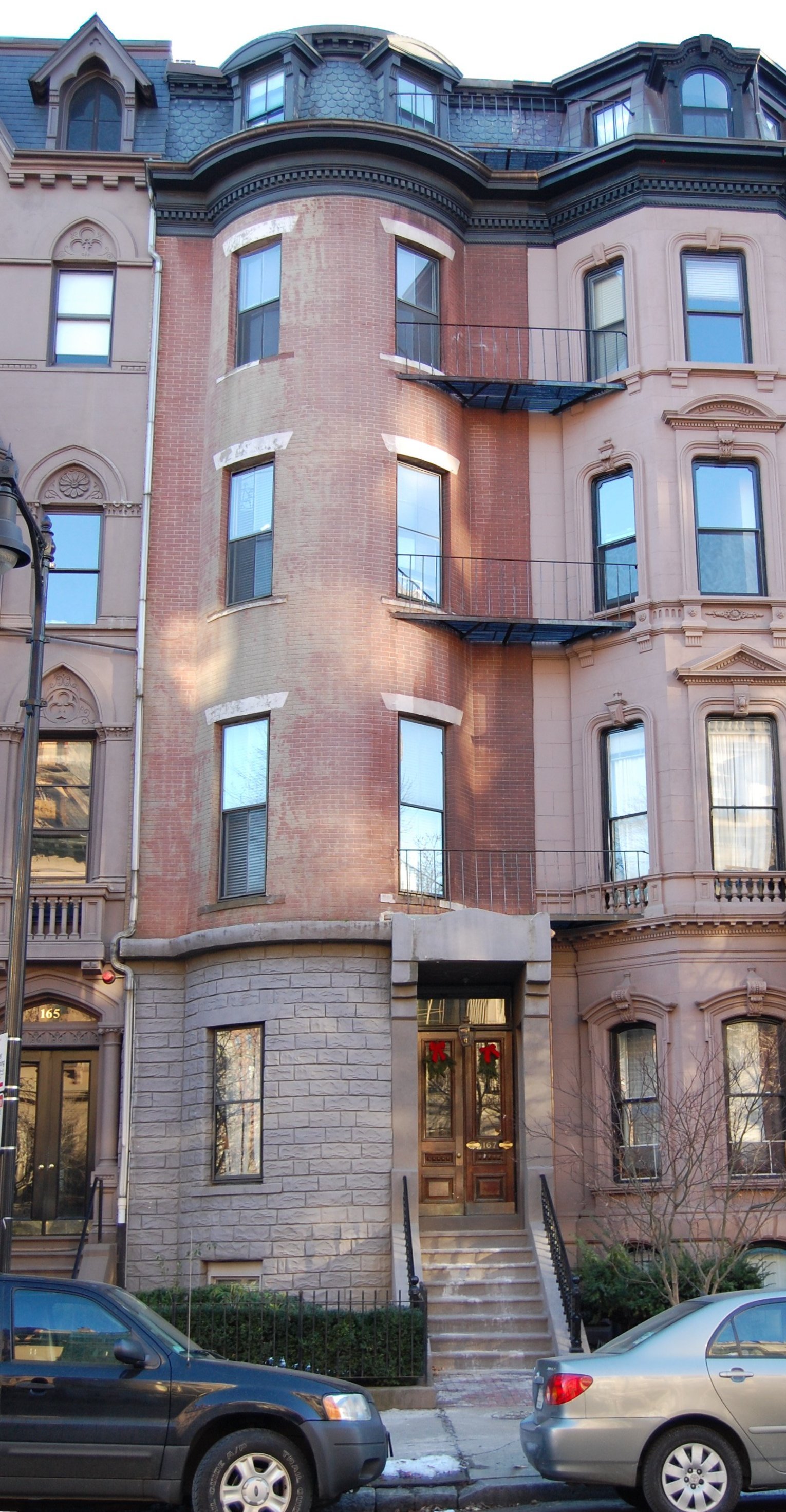
167 Beacon (2013)
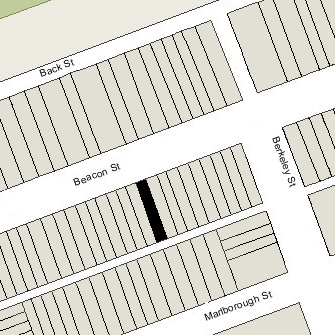
Lot 19′ x 112′ (2,128 sf)
167 Beacon is located on the south side of Beacon, between Berkeley and Clarendon, with 165 Beacon to the east and 169 Beacon to the west.
167 Beacon was built in 1870-1871 for real estate real estate dealer Henry Whitwell, one of four houses (161-163-165-167 Beacon) built on land he purchased on October 21, 1861, from shipping merchant and US Congressman Samuel Hooper.
When it was built, 167 Beacon had a brownstone façade. Sometime after the early 1940s (when this original façade is still shown in photographs), the front was resurfaced at the basement and first floor levels, with brick above. The lintels above the windows and other original details also were removed.
The original parcel where 161-167 Beacon were built had a 78 foot frontage. It had been purchased from the Commonwealth of Massachusetts on September 10, 1859, by George Goss and Norman Carmine Munson, the contractors responsible for filling the Commonwealth’s Back Bay lands. On the same day, they had sold it to banker Franklin Haven (one of the three Commissioners on the Back Bay responsible for the sale of the Commonwealth’s land), who then sold it on December 17, 1859, to Samuel Hooper.
Henry Whitwell subdivided the parcel into a 19 foot 6 inch lot at 161 Beacon, an 18 foot lot at 163 Beacon, a 20 foot lot at 165 Beacon, and a 19 foot lot at 167 Beacon, leaving an additional one foot six inches at the western boundary of his land. He sold the lot at 161 Beacon in August of 1863 to architect James Hovey Rand, who already was building a house on it. After it was completed, he offered it for sale at public auction and Henry Whitwell purchased it and made it his home.
Click here for an index to the deeds for 167 Beacon, and click here for further information about the land between the south side of Beacon and Alley 420, from Berkeley to Clarendon.
On February 8. 1865, Henry Whitwell sold the lot at 167 Beacon to Arthur Lithgow Devens, and on November 17, 1865, he sold him the additional one foot 6 inch strip of land (that same day, Arthur Devens sold the strip of land to Paul Wallis who combined it with the land where 169 Beacon was built).
Alfred Devens was a lawyer and businessman, a partner in J. W. Paige & Company, dealers in domestic goods, and (from 1862) treasurer of the Appleton and Hamilton Manufacturing Companies in Lowell. He and his wife, Agnes Russell (Elwood) Devens, lived at 3 Chestnut.
Henry Whitwell lived at 161 Beacon with his parents, Samuel Whitwell and Sophia (Story) Whitwell, and his unmarried sister and brother, Sophia Louisa Whitwell and Samuel Horatio Whitwell (who also was his business partner). He also continued to own the lot at 163 Beacon.
Alfred Devens died in July of 1867 and on June 14, 1870, Henry Whitwell bought back the lot at 167 Beacon from his estate. On October 10, 1870, he filed with the Board of Aldermen a Notice of Intention to Build at 163 Beacon and 167 Beacon.
Henry Whitwell’s mother had died in December of 1867 and his father died in March of 1871. Soon after their father’s death, Henry, Sophia, and S. Horatio Whitwell moved from 161 Beacon to the new house at 167 Beacon. They continued to live at 167 Beacon until about 1875, when they moved to 111 Commonwealth.
On March 16, 1875, 167 Beacon was purchased from Henry Whitwell by Francis Henry Appleton. He and his wife, Fanny Rollins (Tappan) Appleton, made it their home. They had married in June of 1874. Prior to their marriage, he had lived at 26 Commonwealth with his step-father and mother, Henry and Georgiana (Silsbee) Appleton Saltonstall, and she had lived at 155 Beacon with her parents, Sewall and Elizabeth Sawyer (Rollins) Tappan.
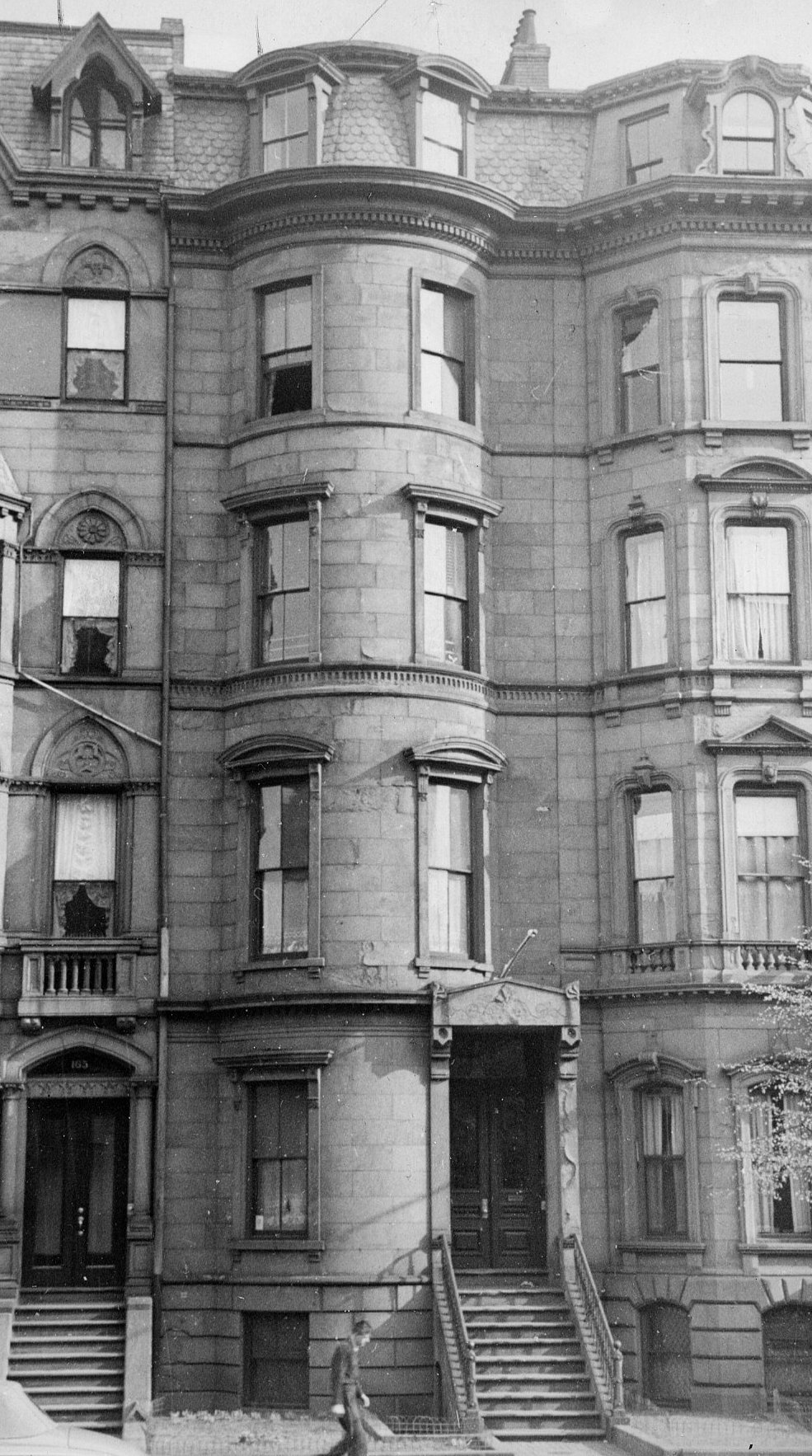
167 Beacon (ca. 1942), photograph by Bainbridge Bunting, courtesy of The Gleason Partnership
Francis Henry Appleton served in the First Corps of Cadets from 1870, rising to the rank of Captain in 1879. In 1897, he was named Commissioner General of Massachusetts, retiring in 1900 with the rank of Major General.
The Appletons also maintained a home and farm on Suntaug Lake in Lynnfield/Peabody where he bred Ayrshire cattle. His step-father, Henry Saltonstall, owned the adjoining property.
The Appletons continued to live at 167 Beacon during the 1879-1880 winter season. Fanny Appleton’s father, Sewall Tappan, died in November of 1879. In February of 1880, Francis Appleton purchased land at 265 Commonwealth and built a new home on the site. While it was under construction they lived at 155 Beacon with her mother. They and her mother had moved to the new house by the 1881-1882 winter season.
On September 29, 1880, 167 Beacon was purchased from Francis Appleton by attorney Charles Alfred Welch. He and his wife, Mary Love (Boott) Welch, made it their home. They previously had lived in Waltham. The Welches continued to live at 167 Beacon during the 1895-1896 winter season, but moved soon thereafter to Cohasset.
On May 1, 1896, 167 Beacon was purchased from Charles Welch by Dr. William Allen Brooks, Jr., and on the same day, he transferred into the name of his wife, Helen (Winchell) Brooks. They previously had lived in an apartment at 259 Beacon. They also maintained a home, The Bungalow, in Lincoln.
Dr. Brooks was a physician and surgeon, and also maintained his office at 167 Beacon. During the influenza epidemic in the Fall of 1918, he established the Corey Hill Cubicle Hospital, an open-air hospital on Corey Hill.
Helen Brooks died in October of 1919 and he moved to Lincoln soon thereafter. He died in May of 1921.
167 Beacon was not listed in the 1921 Blue Book.
By the 1921-1922 winter season, 167 Beacon was the home of Dennis John Mahoney and his wife, Mary Angeline (O’Brien) Mahoney, who leased the house from William Brooks’s estate. They previously had lived in Sharon, Massachusetts, with Mary Mahoney’s father, John O’Brien.
Dennis Mahoney was a furniture salesman and later a chinaware buyer. Mary Mahoney was a reporter for the Boston Globe and later served as women’s club editor for the newspaper. In her March 27, 1959, obituary in the Globe, she was described as “something of a legend in the newspaper trade – a girl reporter years ago in the tradition of Nelly Bly.”
John O’Brien, Mary Mahoney’s father, was a former grocer and real estate investor, who served on the Boston Common Council and as Overseer of the Poor in the 1870s. He was one of the original organizers of the St. Vincent de Paul Society, and, in 1922, he donated the building and land in Sharon for a school to be operated by the Brotherhood of the Sacred Heart, which he contributed in memory of his wife, Mary A. E. (Donovan) O’Brien, who died in November of 1919. At the time of his death in January of 1925, he was living at 167 Beacon.
Mary Mahoney’s sister, Gertrude G. O’Brien, lived at 167 Beacon with the Mahoneys. She was a teacher.
On March 7, 1924, Gertrude O’Brien purchased 167 Beacon from William Brooks’s estate, and on December 27, 1940, Mary Mahoney acquired the house from her sister. They all continued to live there until about 1953.
On September 25, 1953, 167 Beacon was acquired by Sanford Lee Fisher, president of Fisher Junior College.
On May 18, 1954, 167 Beacon was acquired from Sanford Fisher by the Kirby Realty Corporation. That same month, it applied for (and subsequently received) permission to convert the house from a single-family dwelling into twelve apartments.
On September 30, 1968, the Kirby Realty Corporation transferred 167 Beacon to Mary E. Kirby, its president and treasurer.
On July 2, 1979, Mary E. Kirby converted the property into twelve condominium units, the 167 Beacon Street Condominium.

