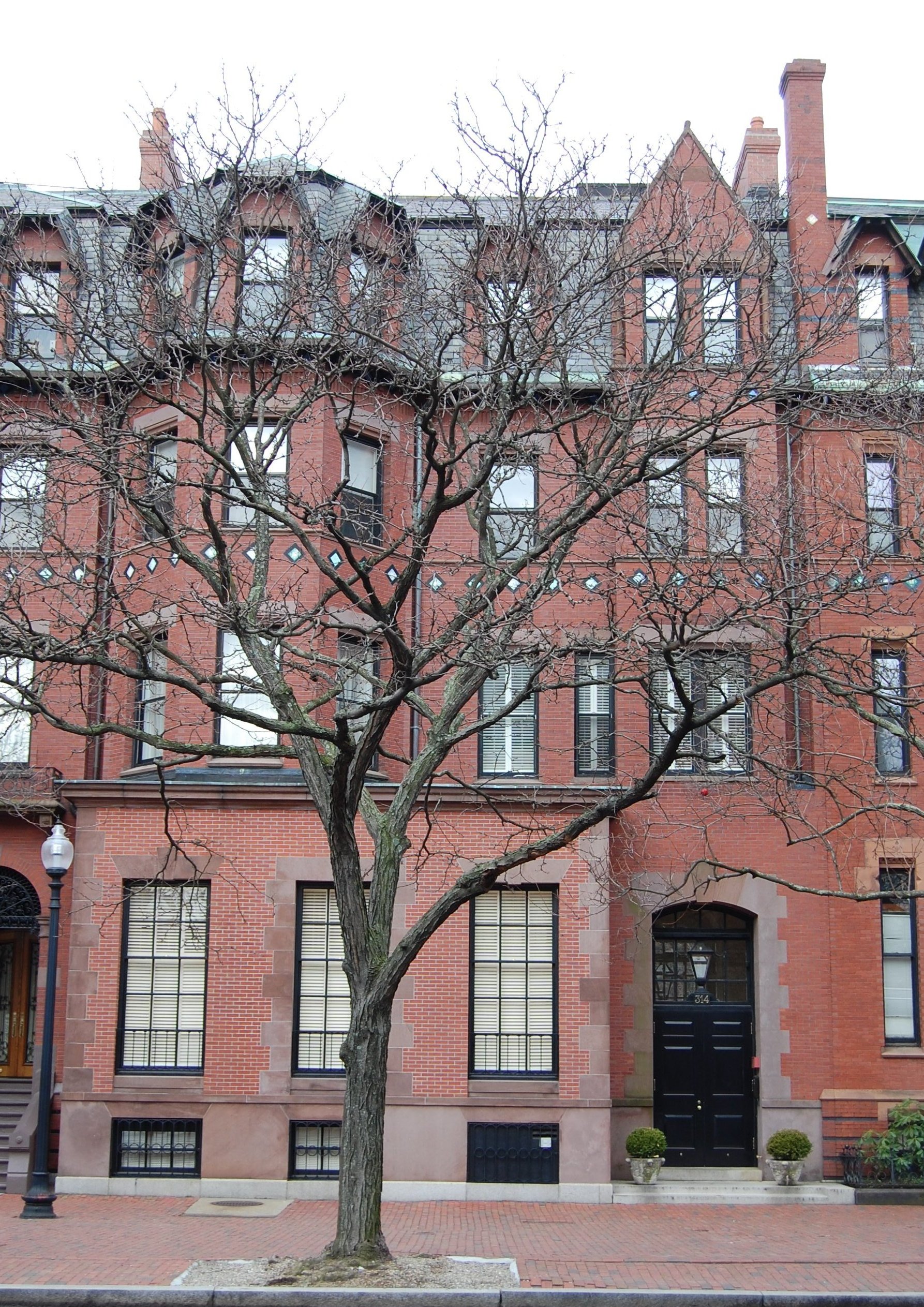
314 Dartmouth (2013)
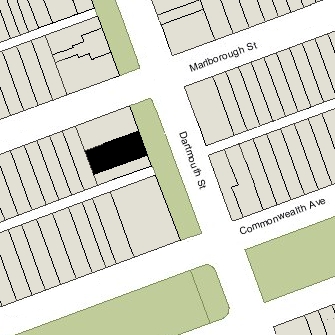
Lot 40′ x 105′ (4,200 sf)
314 Dartmouth is located on the west side of Dartmouth, between Marlborough and Commonwealth, with 164 Marlborough to the north and 312 Dartmouth to the south.
314 Dartmouth was built in 1871 by building contractor George Wheatland, Jr., one of two contiguous houses (312-314 Dartmouth).
312-314 Dartmouth were built on part of a larger parcel of land that George Wheatland, Jr., acquired from the Commonwealth of Massachusetts, and that also included the land where 164 Marlborough would be built. He originally purchased the land at the Commonwealth’s auction on April 10, 1869, and then entered into agreements on August 23, 1869, and January 29, 1870, with Katharine (Bradlee) Crowninshield, wife of Benjamin William Crowninshield, under which he agreed to sell her the lot for 164 Marlborough once the Crowninshields had built their home on it. 164 Marlborough was completed in late 1870, the Commonwealth conveyed the land to George Wheatland, Jr., on November 15, 1870, and he conveyed the lot for 164 Marlborough to Katharine Crowninshield on December 15. 1870. He retained the land for 312-314 Dartmouth and began construction soon thereafter.
The original lot acquired from the Commonwealth by George Wheatland, Jr., was 80 feet wide (east-west). On December 9, 1870, Eben D. Jordan purchased from the Commonwealth the 25 foot wide lot immediately to the west, and on December 15, 1870, he sold a 7 foot wide strip to George Wheatland, Jr. That same day, George Wheatland, Jr., sold the 7 foot strip at the west of 164 Marlborough to Katharine Crowninshield, increasing the frontage of her lot to 87 feet on Marlborough. He retained the strip behind 312-314 Dartmouth. On April 30, 1874, Eben Jordan sold the remainder of his lot, with an 18 foot width, to George Tyson, by then the owner of 314 Dartmouth, and on July 7, 1874, George Tyson sold the portion behind 164 Marlborough to Katharine Crowninshield, and the portion behind 312 Dartmouth to Catherine Fay, owner of 312 Dartmouth, increasing the east-west depth of each lot to 105 feet.
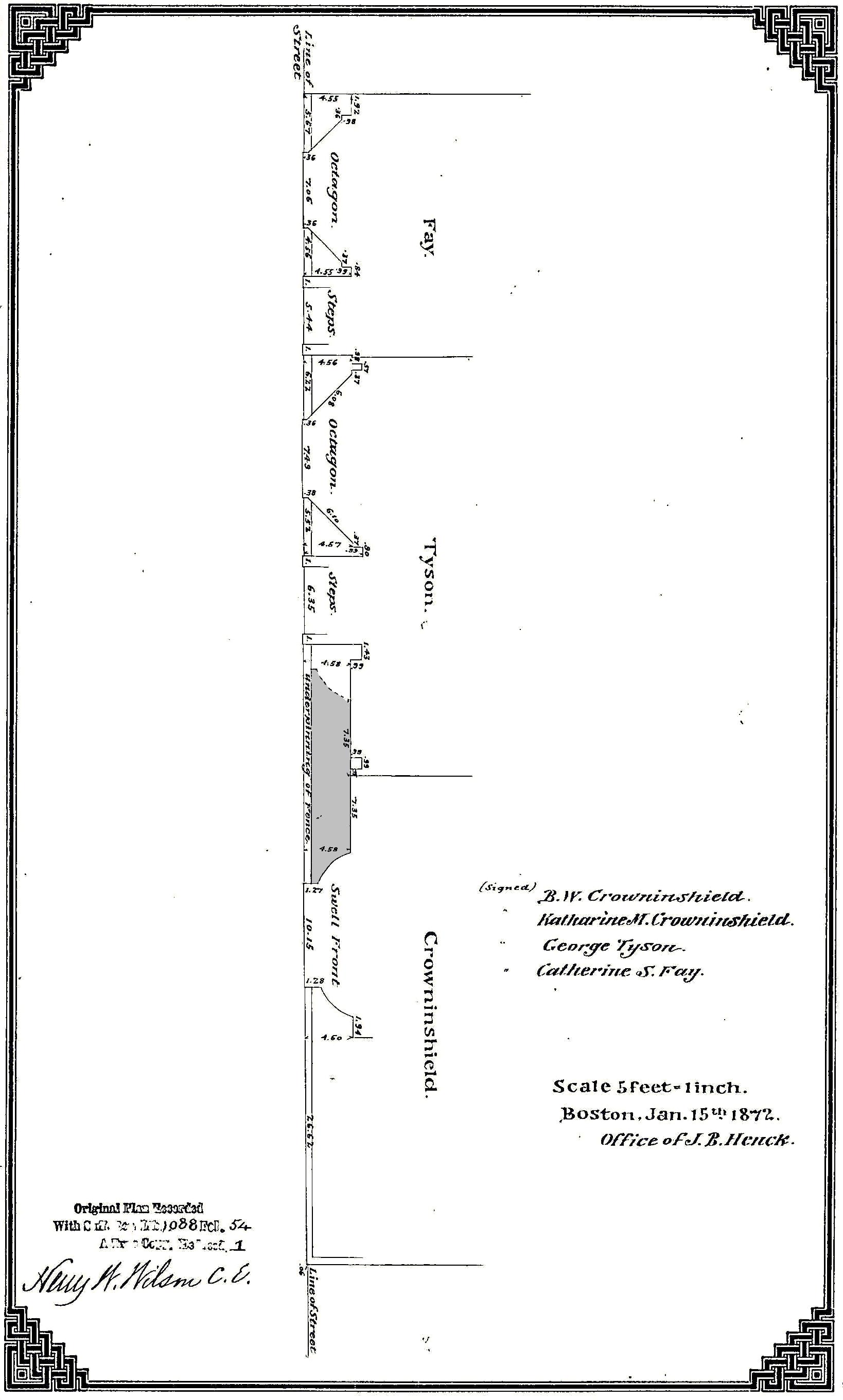
Plot plan from January of 1872 showing line of Dartmouth Street façades of 164 Marlborough and 312-314 Dartmouth as built (area where future building is prohibited shown in grey); filed with owners’ agreement, Suffolk County Deed Registry, Book 1088, p. 54 (12Jan1872)
In the December 15, 1870, deed transferring the land to Katharine Crowninshield, George Wheatland, Jr., had agreed to restrictions on the dimensions of the houses he would build at 312-314 Dartmouth so that they would conform with the house already constructed at 164 Marlborough. That agreement also specified that nothing would be built on a small strip of land on Dartmouth Street, about 4.5 feet deep and extending about 7.3 feet at the face of the buildings on either side of the property line between 164 Marlborough and 314 Dartmouth.
On January 12, 1872, after 312-314 Dartmouth were completed, their new owners and Katharine Crowninshield of 164 Marlborough entered into an agreement confirming that the dimensional requirements in the earlier deeds had been met and extending in perpetuity the prohibition on building on the small strip between 164 Marlborough and 314 Dartmouth.
The various deeds and agreements also specified a five foot (later four foot) wide easement at the western edge of 312-314 Dartmouth providing access to the alley for sewer drainage for all three properties and right-of-way access for 314 Dartmouth.
Click here for an index to the deeds for 314 Dartmouth, and click here for further information about the land between the south side of Marlborough and Alley 425, from Dartmouth to Exeter.
Bainbridge Bunting, in his Houses of Boston’s Back Bay does not attribute 312-314 Dartmouth to a specific architect. They are built in the style of 164 Marlborough, including distinctive dormers and a string course of blue, green and white tiles between the second and third stories. 164 Marlborough was designed by architect Henry Hobson Richardson. However, Jeffrey Karl Ochsner’s H. H. Richardson Complete Architectural Works states that “there is no evidence to indicate that [312-314 Dartmouth] were designed by Richardson.”
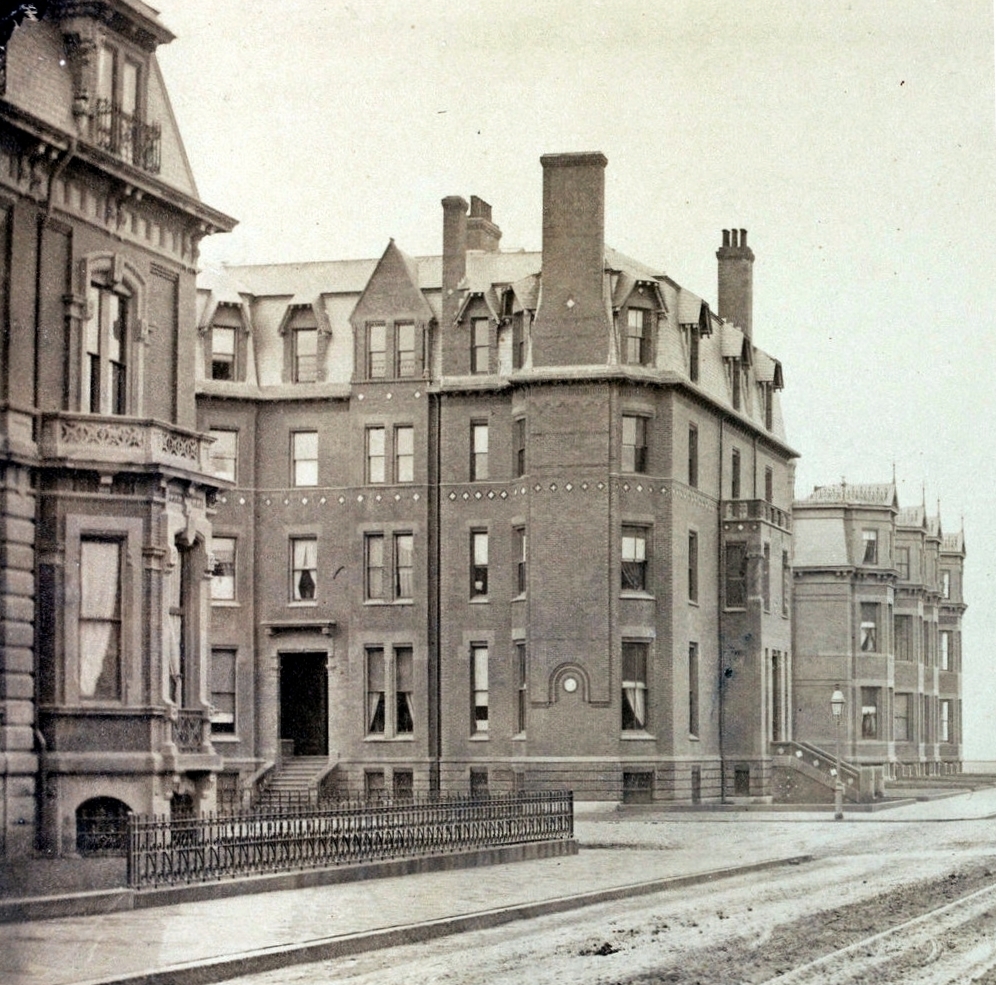
Detail from a photograph looking west on Marlborough (ca. 1875), showing the northern portion of the façade of 314 Dartmouth; courtesy of Historic New England
When it was built, 314 Dartmouth had an angled bay extending from the ground level on the southern half of its façade. To the right of the bay was the entrance, up a flight of stairs, and to the right of the entrance was a slightly projected flat façade with windows, continuing up to a gable. Sometime between 1908 and 1912, the façade was remodeled to move the entrance into the northern third of the building, at street level, and square off the first story of the angled bay. An oriel window was installed above the new entrance. Sometime between 1949 and 1970 this oriel was removed and replaced with a pair of windows.
On January 1, 1872, 314 Dartmouth was purchased from George Wheatland, Jr., by
George Tyson. He and his wife, Sarah (Anthony) Tyson, made it their home. They previously had lived at 232 Beacon.
George Tyson was former partner in Russell and Company, the China merchant trading firm, and had spent much of the 1860s in Shanghai. After returning to Boston, he retired from his partnership in Russell and Company and became a partner in J. M. Forbes & Co., shipping merchants in the China trade and investors in railroads and real estate.
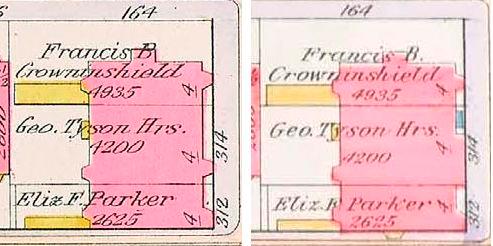
1908 and 1912 Bromley maps, showing alteration of the front of 314 Dartmouth
Sarah Tyson died in February of 1873 and in 1875 George Tyson married again, to Emily Davis of Philadelphia. They continued to live at 314 Dartmouth with his three children from his first marriage: Russell Tyson, George Tyson, Jr., and Elizabeth Russell Tyson.
George Tyson died in January of 1881.
Emily Tyson continued to live at 314 Dartmouth with her step-children. She also maintained a home, Eagle Rock, in Pride’s Crossing, which she sold to Henry C. Frick in 1902 (who tore it down but retained the name Eagle Rock).
Russell Tyson married in June of 1891 to Sarah Merry Bradley of 122 Commonwealth. After their marriage, they lived in Milton and then in Chicago, where he was a real estate dealer.
During the 1896-1897 winter season, the Tysons were living elsewhere and 314 Dartmouth was the home of James Hewitt Morgan and his wife, Martha Young (Leavitt) Morgan. They had recently returned from Paris, where he had studied architecture at the Ecole des Beaux Arts, and were in Boston with the intention of his entering Harvard Law School (which he ultimately did not do). By the next season, they had moved to 509 Beacon and Emily Tyson and her unmarried stepchildren, George and Elizabeth, were once again living at 314 Dartmouth.
In 1898, Emily Tyson and her step-daughter, Elizabeth, acquired Hamilton House in South Berwick, Maine, which they restored and made their summer home.
Elizabeth Tyson married in April of 1915 to Henry Goodwin Vaughan, an attorney (and fox hunting aficionado). After their marriage, they lived in Sherborn. Emily Tyson and George Tyson, Jr., a banker and stockbroker, continued to live at 314 Dartmouth.
By the 1918-1919 winter season, the Vaughans were living at 314 Dartmouth with George Tyson, Jr. They also retained their home in Sherborn. Emily Tyson was living elsewhere during the 1918-1919 and 1919-1920 seasons, but then resumed living there, with the Vaughans and George Tyson, Jr.
Emily Tyson died in June of 1922. The Vaughans resumed living in Sherborn and George Tyson, Jr., moved to the Hotel Kenmore.
By the 1922-1923 winter season, 314 Dartmouth had become the home of attorney Pierpont Langley Stackpole and his wife, Lora (McGinley) Knowles Stackpole. They had married in May of 1922 and 314 Dartmouth probably was their first home together. Her children by her marriage to Lucius James Knowles — Lucius, Jr., and Sarah Montgomery Knowles — lived with them (Lucius James Knowles, Sr., had died in November of 1920). They continued to live at 314 Dartmouth during the 1923-1924 season, but moved soon thereafter to 53 Marlborough.
On October 9, 1924, 314 Dartmouth was purchased from the Tyson estate by Barbara (Deering) Danielson, the wife of Richard Ely Danielson. They previously had lived in Groton, where they continued to maintain a home.
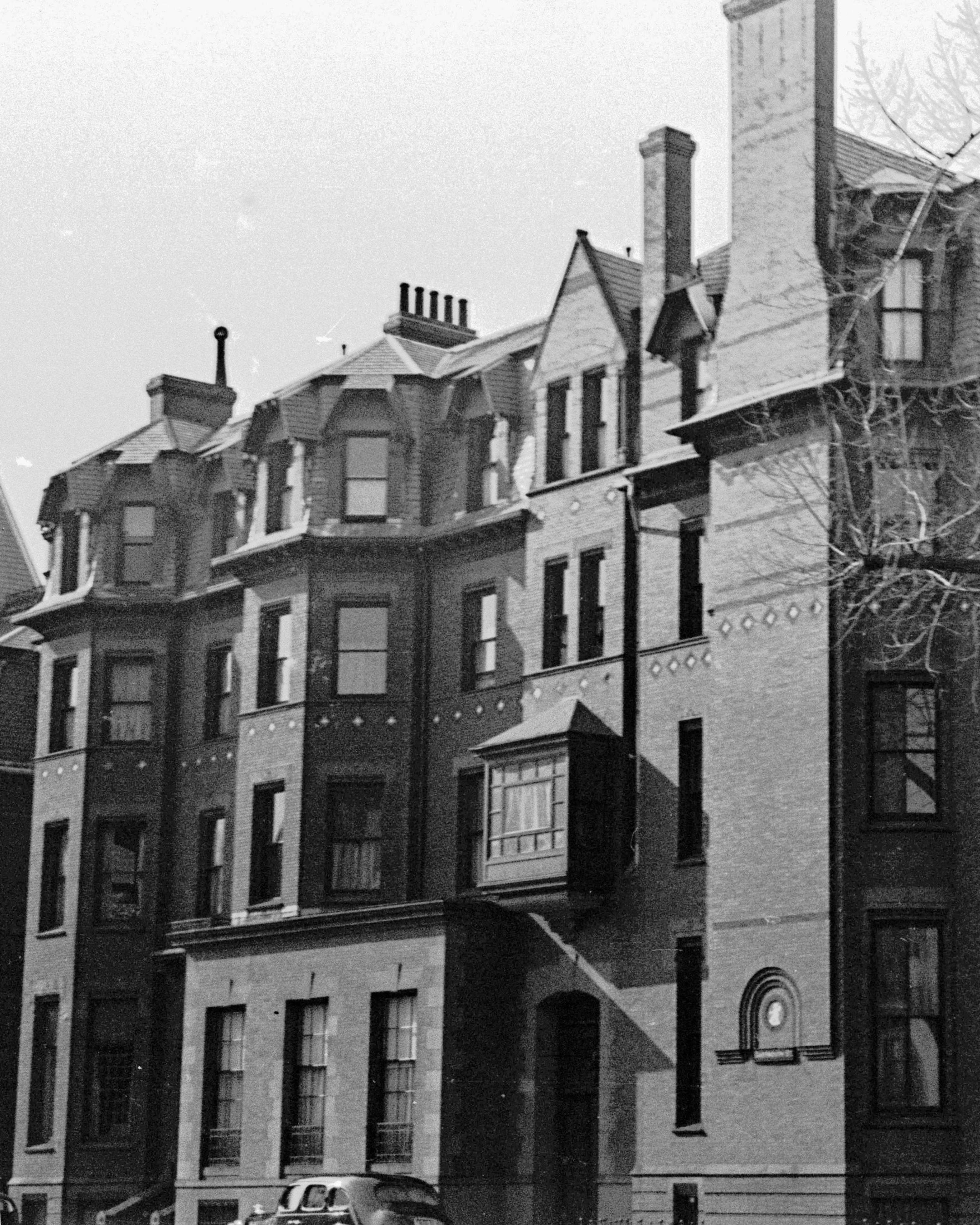
314 Dartmouth (ca. 1942), photograph from negative by Bainbridge Bunting, courtesy of the Boston Public Library Arts Department and Digital Commonwealth; licensed under a Creative Commons Attribution Non-Commercial No Derivatives License.
Earlier in 1924, Richard Danielson and Christian Herter (future Governor of Massachusetts) had purchased The Independent, a fortnightly magazine previously published in New York. Richard Danielson served as its editor and publisher until 1928. He was editor and publisher of The Sportsman until 1937. From 1940 until his death in 1957 he was president and associate editor of the Atlantic Monthly.
The Danielsons continued to live at 314 Dartmouth in 1942. The house was shown as vacant in the 1943-1945 City Directories while Richard Danielson was serving in the US Army, but was again the Danielsons’ home in 1947.
On December 27, 1948, 314 Dartmouth was purchased from Barbara Danielson by real estate dealer Henry J. O’Meara.
On January 24, 1949, it was acquired by the American National Red Cross for use as a blood bank by their Boston Metropolitan Chapter. In July of 1949, the Red Cross applied for (and subsequently received) permission to remodel the interior of the building and change the legal occupancy from a residence to a Red Cross blood bank.
On January 27, 1970, 314 Commonwealth was acquired from the Red Cross by the Society of Jesus of New England. They used the house for offices and a chapel.
In June of 1972, the Jesuits acquired 312 Dartmouth from the Teresian Institute and used the building for a rectory with an accessory chapel.
In January of 1983, the Jesuits filed for (and subsequently received) permission to combine 312 and 314 Dartmouth into one building to be used as a chapel and offices, including establishing that the legal use of 312 Dartmouth was as offices, which they indicated had been the use for a number of years. In March of 1983, they filed for (and subsequently received) permission to change to legal occupancy of both buildings to offices.
On March 21, 1983, the Society of Jesus sold 312-314 Dartmouth to Swiss Properties, Inc. It owned the property as part of the Dartmouth Street Limited Partnership, described in an April 9, 1983, Boston Globe news item on the sale as “comprising Hub architectural firm of Ahearn, Schopfer & Associates and Swiss Properties of Bethesda, Md.”
314 Dartmouth subsequently was occupied as offices, including (among others, the Boston Publishing Company and Childs, Bertman & Tseckares, architects.
Back Bay residents filed an appeal of the Inspectional Services Department’s decision granting the use of 312-314 Dartmouth for offices. In October of 1983, the Board of Appeal concurred with respect to 312 Dartmouth. It directed the Commissioner of the Inspectional Services Department to revoke the previous approval to the extent that it allowed the 312 Dartmouth portion of the combined building to be used for offices.
In April of 1987, the Dartmouth Street Limited Partnership filed for approval to remodel 312-314 Dartmouth and change the legal occupancy to offices and eight apartments. The application was unopposed by the community and was approved in July of 1987.
On December 9, 1987, Swiss Properties sold 312-314 Dartmouth to Edgard Puente and David Boersner, trustees of the Boston Dartmouth Realty Trust. On the same day, they converted the property into three commercial condominium units and six residential condominium units, the 312-314 Dartmouth Street Condominium.
On February 27, 1992, the condominium association amended the master deed to reduce the number of units to four, one commercial unit on the basement and first floor levels and three residential units. On April of 1992, Paul Cohen, owner of all but one of the units, filed for (and subsequently received) permission to remodel the building and change the occupancy to four apartments and one office.
On December 7, 1992, the condominium association further amended the master deed to increase the number of units to five, one commercial or residential unit on the basement and first floor levels and four residential units. In December of 1992 Merrill Cohen, owner of one of the units, filed for (and subsequently received) permission to change the legal occupancy to five apartments.
-
- 164 Marlborough and 312-314 Dartmouth (2013)
-
- 312-314 Dartmouth and Dartmouth façade of 164 Marlborough (2013)
 Back Bay Houses