
1 Arlington (2013)

Lot 52′ x 85′ (4,420 sf)
1 Arlington is located on the SW corner of Arlington and Beacon, with 100 Beacon to the northwest, across Beacon, 2 Arlington to the south, and 101 Beacon to the west.
1 Arlington was designed by architects Gridley J. F. Bryant and Arthur Gilman, and built in 1860-1861 by J. E. & N. Brown, carpenters, and Standish & Woodbury, masons, one of three contiguous houses (1-2-3 Arlington) built for clothing manufacturer and real estate investor John Simmons.
The land on which 1-2-3 Arlington were built was originally part of a larger tract purchased from the Commonwealth of Massachusetts on August 1, 1857, by William Warren Goddard and T. Bigelow Lawrence. They sold a corner lot (40 feet on Beacon by 112 feet on Arlington) to John C. Gray on September 1, 1859, and a second lot of the same size, immediately to the west, to John Simmons on October 1, 1859. John Simmons purchased John Gray’s lot on November 1, 1859, and purchased an additional strip of land five feet by 112 feet from Goddard and Lawrence on April 30, 1860, completing a lot which was 112 feet on Arlington and 85 feet on Beacon on which he had 1-2-3 Arlington built.
Click here for an index to the deeds for 1 Arlington, and click here for further information about the land on the south side of Beacon from Arlington to Berkeley, north of Alley 421.
An April 10, 1860, Boston Evening Transcript article reported that J. E. & N. Brown had filed a Notice of Intention with the Board of Alderman to build “on Arlington and Beacon streets.” On May 25, 1860, the Transcript reported that “At the corner of Beacon and Arlington streets the piles are now being driven for a block of three uniform houses, each 30×65 feet, the exteriors to be of Connecticut brown stone, of a highly ornamental character. They are erected under the superintendence of Messrs. J. E. & N. Brown, for John Simmons, esq., and are intended to be finished throughout in a style equal to the best houses in that vicinity.” On August 7, 1861, the Boston Traveller reported that the three houses were “nearly completed.”
In his Houses of Boston’s Back Bay, Bainbridge Bunting indicates that 1-2-3 Arlington “probably” were designed by Gridley Bryant. A September 24, 1860, article in the Boston Post confirms that the architect was Gridley Bryant, as does a May 6, 1862, advertisement published in the Boston Evening Transcript by John Simmons, offering two of the three houses for sale.
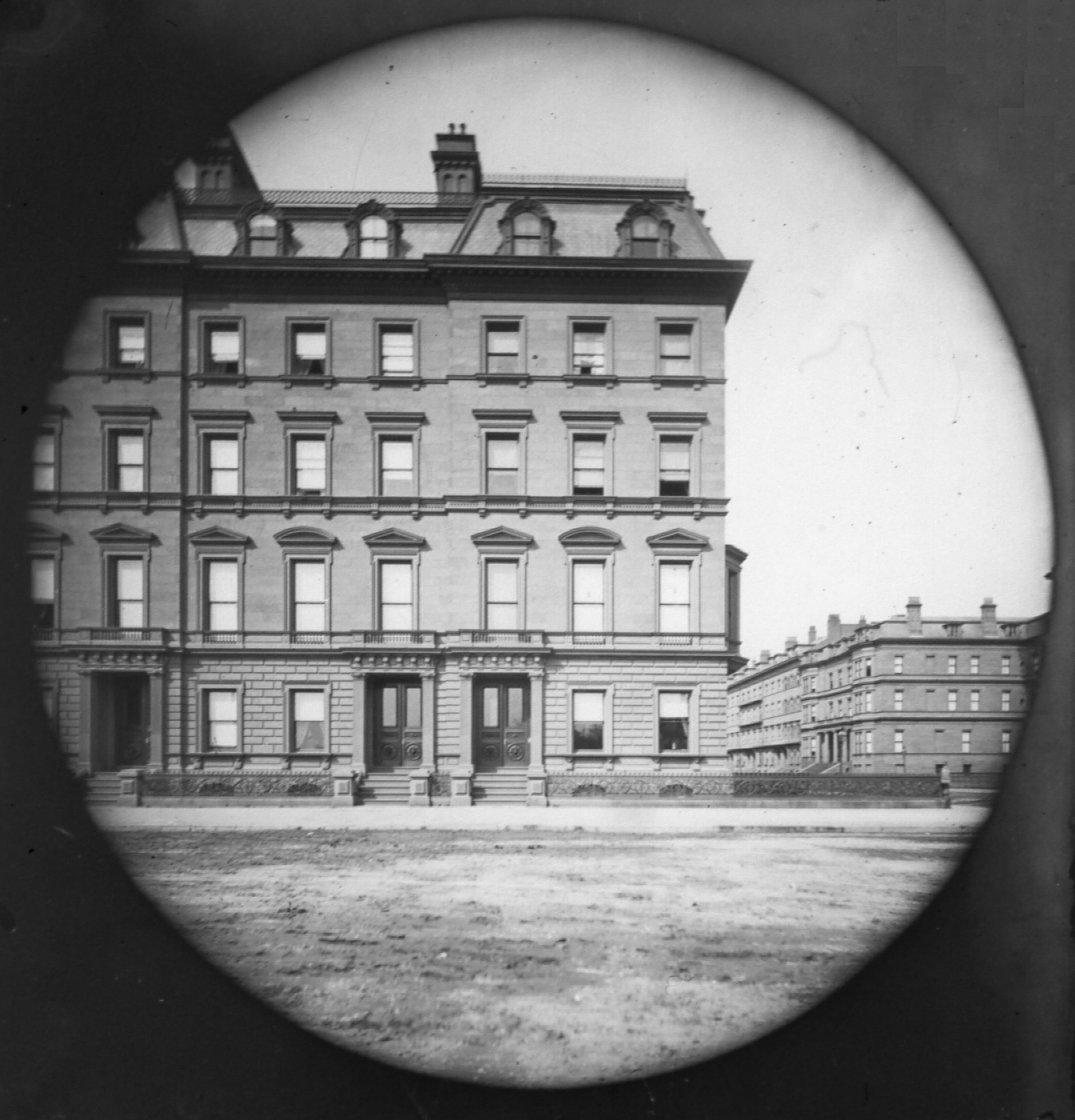
1-2 Arlington (ca. 1867); Josiah Johnson Hawes Col-lection (#454), courtesy of The John F. Kennedy Li-brary Foundation, Boston (licensed by The John F. Kennedy Library Foundation. all rights reserved).
Roger Reed, in his Building Victorian Boston: The Architecture of Gridley J. F. Bryant states that they were designed by Bryant in association with Arthur Gilman. He cites the May 25, 1860, Boston Evening Transcript article as his source (that article discusses a number of houses and states that thirteen of them were by Bryant and Gilman, without providing specific addresses).
1-2-3 Arlington were designed to give the appearance of one large, monumental building, in the French Academic style popular in Paris during the 1850s and 1860s. 2 Arlington – the middle house – is set slightly further back from the street than the two surrounding houses, whose mansard roofs project outwards slightly to frame it. As originally designed, there was a five foot wide passageway at the rear of 2 and 3 Arlington, running parallel to Arlington and underneath the rear ells, to provide access to the alley for all three houses.
On June 22, 1863, 1 Arlington was purchased from John Simmons by William Fletcher Weld. He and his wife, Isabella Melissa (Walker) Weld, made it their home. They previously had lived at 65 Bowdoin.
William F. Weld was a shipping merchant whose firm, William F. Weld & Co., was at one time the largest ship owner in America, sailing under the “Black Horse” flag. He also was a major investor in railroads and real estate.
Living with the Welds were their son, George Walker Weld, and William F. Weld’s daughters from his first marriage (to Mary Perez Bryant), Sarah Minot Weld and Anna Minot Weld.
Sarah Weld married in November of 1869 to George Langdon Pratt, a retired merchant who subsequently became treasurer of several railroads. After their marriage they lived at 3 Joy Street with his mother, Abigail (Lodge) Pratt, the widow of George Langdon Pratt, and his aunt, Mary Walley Lodge. By 1872, they had moved to 127 Commonwealth.
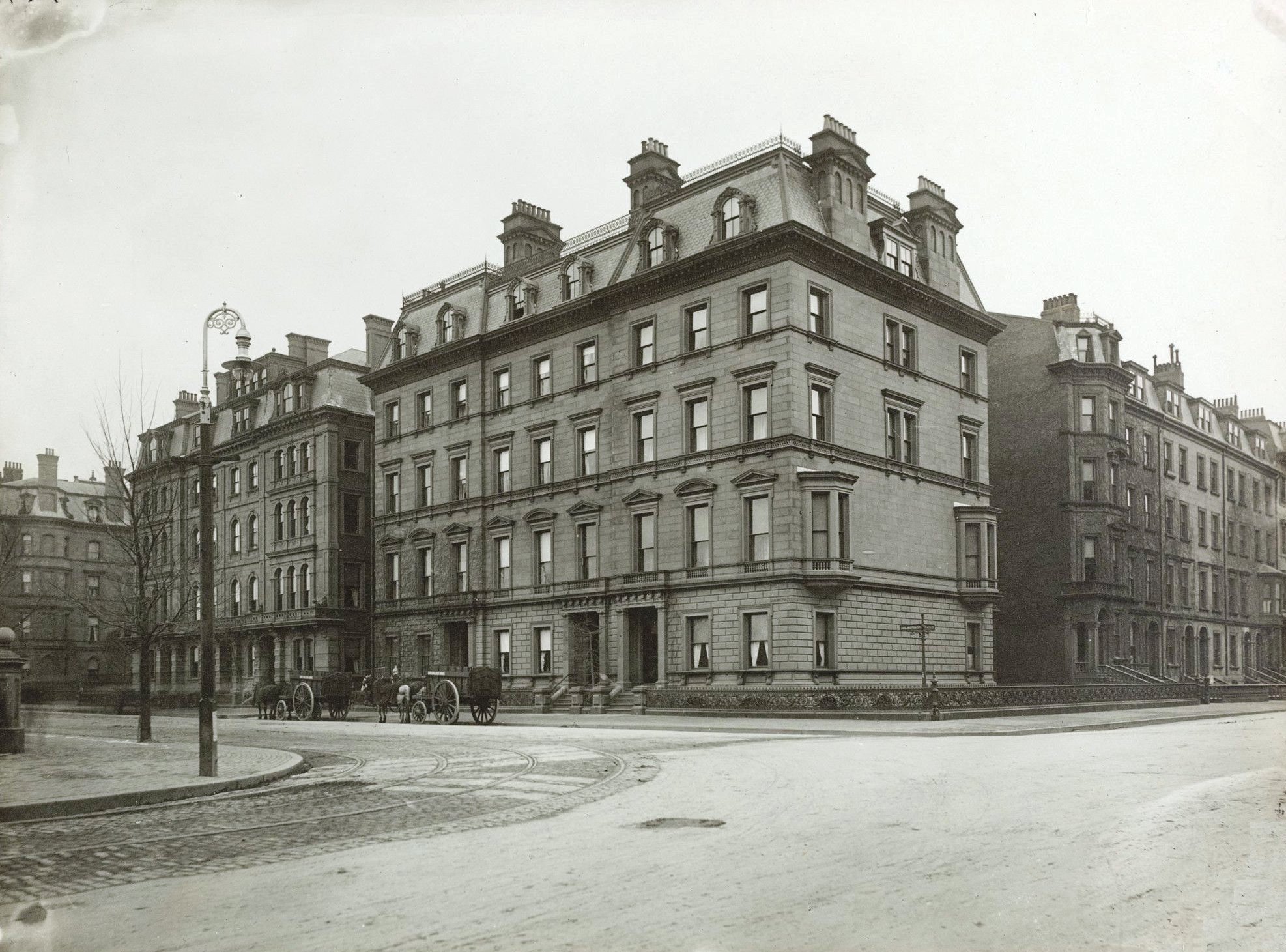
1-7 Arlington (ca. 1880); courtesy of Historic New England
Anna Weld married in September of 1870 to George Hamilton Perkins. He was a Commander in the US Navy and was serving as the Lighthouse Inspector for the Second District. He later would be promoted to Captain and then to Commodore. After their marriage, they lived at 284 Marlborough.
George Pratt died in 1872 and George Walker Weld moved soon thereafter to 127 Commonwealth to live with his half-sister, Sarah.
William and Isabella Weld continued to live at 1 Arlington until about 1879, when they moved to Philadelphia. A June 6, 1897, Boston Globe article on William F. Weld indicated that he “claimed he was excessively taxed by the assessors, and he became so indignant that he decided to leave the city for Philadelphia.” He continued to own 1 Arlington, which appears to have been left vacant. They also maintained a home in Newport. William Weld died in December of 1881. After his death, Isabella Weld moved back to Boston and lived at 115 Commonwealth. George Walker Weld lived with her.
On September 14, 1882, William F. Weld’s estate offered 1 Arlington for sale at auction. The auction notice published in the Boston Journal by Samuel Hatch & Co., auctioneers, noted that “on the main entrance floor is a large reception room, dining and library room, beautiful drawing rooms on second story, and ample chambers and dressing rooms above, with bath rooms, water closets, and the best of plumbing throughout the house. Heavy plate glass windows.”
The successful bidder was Leonard Richardson Cutter, who took title from the Weld estate on October 9, 1882. He and his wife Mercy Fairbank (Taylor) Cutter, made it their home. They previously had lived at 27 Hancock.
Leonard Cutter was a builder and real estate investor, and served at various times as Assessor, Alderman, Member of the Boston Water Board, and Water Commissioner. He also served as interim Mayor of Boston in 1873.
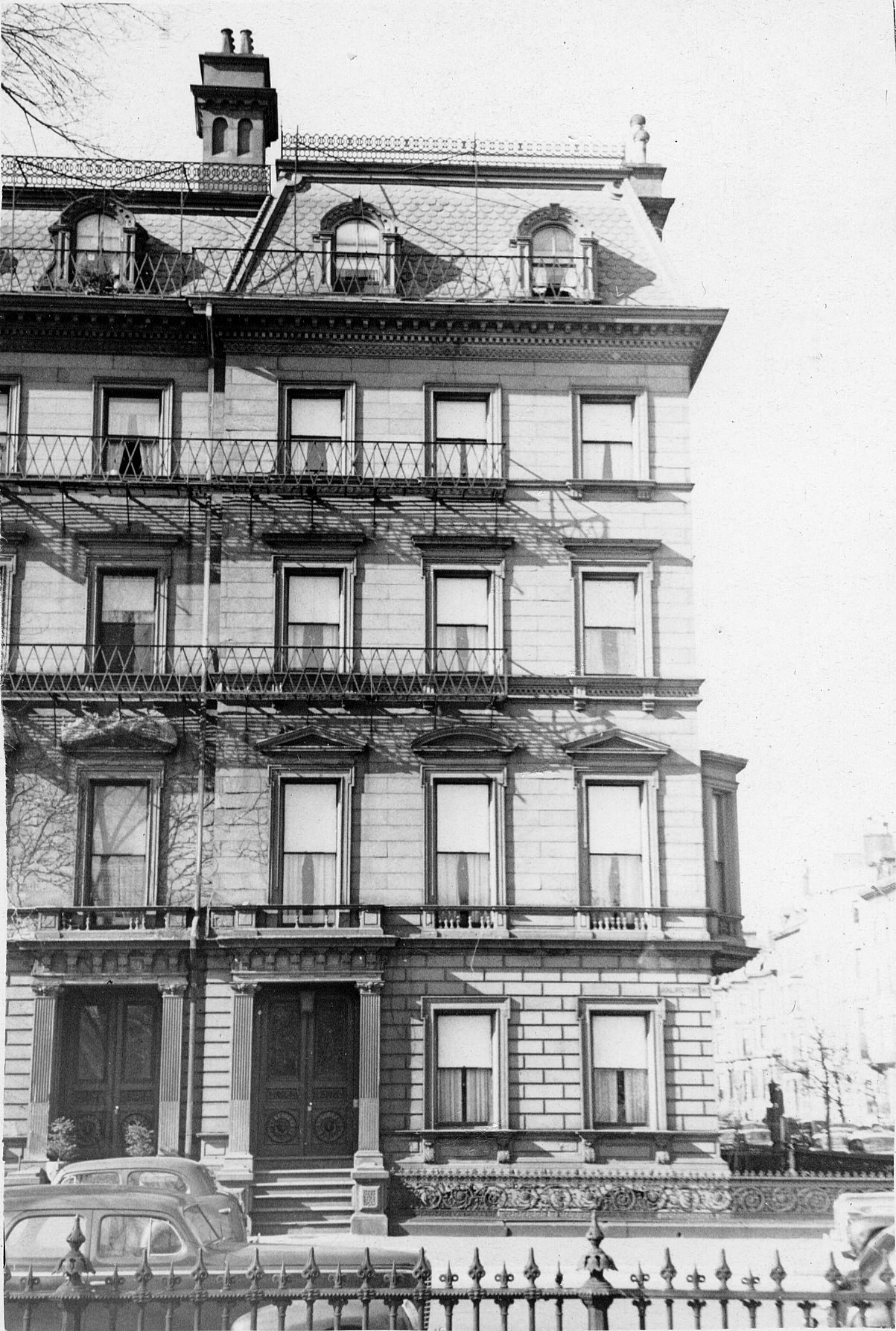
1 Arlington (ca. 1942), photograph by Bainbridge Bunting, courtesy of The Gleason Partnership
The Cutters’ two daughters, Agnes Elizabeth Cutter and Emma Adelaide Cutter, lived with them.
Emma Cutter married in March of 1885 to Horace Willard Baxter, Jr., a bookkeeper in a bank and later a real estate investor and trustee in association with Leonard Cutter. After their marriage, they lived in Brighton with his parents, Horace W. Baxter and Elizabeth Corey (Davis) Baxter.
Agnes Cutter married in November of 1887 to Dr. Enos Hoyt Bigelow, a physician. After their marriage, they lived in Framingham.
The Cutters continued to live at 1 Arlington until their deaths in 1894: Mercy Cutter in January of 1894 and Leonard Cutter in July of 1894.
The Cutters’ daughter, Emma (Cutter) Baxter died in November of 1894, and Horace Baxter, Jr., moved to 1 Arlington soon thereafter. The house was owned by Leonard Cutter’s estate, with Horace Baxter, Jr, and Agnes Elizabeth (Cutter) Bigelow as trustees.
In September of 1905, Horace Baxter, Jr., married again, to Sarah Elizabeth Jenks, and they moved to 524 Commonwealth.
1 Arlington continued to be owned by the Cutter estate. It was not listed in the 1907-1909 Blue Books.
By 1910, 1 Arlington was the home of Mrs. Celia E. Murray, who operated it as a lodging house. She continued to live there until about 1917, when she moved to 14 Newbury.
By the 1917-1918 winter season, 1 Arlington was the home of William Allen McCarthy, a picture frame gilder, and his wife, Mary J. (Barrett) McCarthy, who operated it as a lodging house. They previously had lived at 376 Newbury. They continued to live at 1 Arlington in 1920, but had moved to 31 Newbury by 1921.
On August 12, 1920, 1 Arlington was acquired from the Cutter estate by attorney John D. Graham. On the same day, he transferred the property to the Roman Catholic Archbishop of Boston.
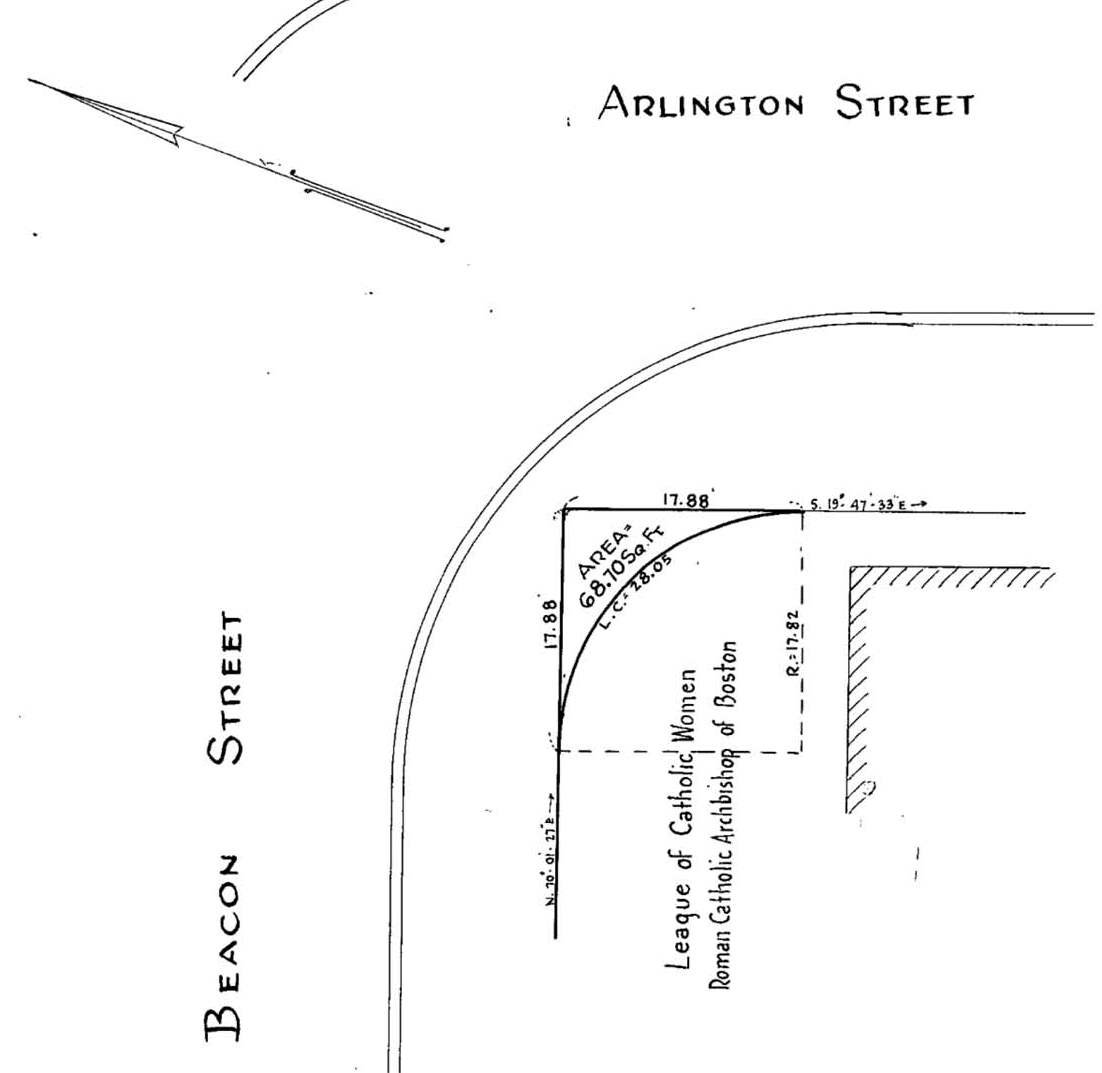
Plan of land taken by eminent domain at the SW corner of Arlington and Beacon, September 1951; Suffolk County Deed Registry, Book 6725, page 78
1 Arlington became the diocesan center of the League of Catholic Women of Boston. An August 14, 1920, Boston Globe article noted that it would be the first “permanent headquarters” of the organization. The League continued to maintain its offices there until about 1968.
In September of 1951, the Commonwealth of Massachusetts Metropolitan District Commission modified the intersection at Arlington and Beacon, creating a curve at the southwest corner that reduced the lot at 1 Arlington by approximately 69 feet.
On August 28, 1968, 1 Arlington was acquired from the Roman Catholic Archbishop of Boston by the One Arlington Associates LP, a partnership of Daniel J. Finn, Joseph M. Krol, William E. Sayers, and Francis B. Sellew.
In December of 1968, the One Fifty Four Beacon Street Associates LP (another partnership of the same co-venturers) filed for (and subsequently received) permission to convert the property from a club (the League of Catholic Women) into ten apartments.
On August 1, 1969, 1 Arlington was acquired from the One Arlington Street Associates LP by the Unitrust Corporation. On February 18, 1976, the South Boston Savings Bank foreclosed their mortgage to the Unitrust Corporation and sold 1 Arlington to Joseph Jokton DeMarco. He and his wife, Ute D. (Brammer) DeMarco, lived in Newton.
Joseph and Ute DeMarco owned and operated the Boston School of Modern Languages, located at 795 Boylston, and moved the school to 1 Arlington after purchasing the building. In January of 1980 he was cited for failing to change the legal occupancy of the property, and in February of 1980 he he applied for (and subsequently received) permission to convert the property from ten apartments to a language school. The school remained there until the late 1980s, when it moved to Roslindale. Emerson College subsequently occupied the building for office space.
Joseph Jokton DeMarco died in November of 1994 and 1 Arlington was inherited by Ute DeMarco. She continued as president of the Boston School of Modern Languages. In October of 1998, she married again, to Count Jochen von Haller.
In November of 1998, Ute DeMarco von Haller applied for a permit to change the use of the “existing school offices on 4th and 5th floors” to “doctors offices and electrology.” The permit was abandoned and the legal occupancy remained a language school, but the building subsequently was occupied by Univeral Resources, a health care staffing firm.
On May 2, 2006, 1 Arlington was acquired from Ute DeMarco von Haller by Fisher College. In March of 2006, prior to taking title to the property, it applied for permission to convert the property from a language school to college use, which was approved by the zoning Board of Appeal in July of 2006. The college subsequently used 1 Arlington for offices for its admissions department, bursar, and other college functions.
As of 2024, Fisher College was the assessed owner of 1 Arlington, 102-104–106–108–110–112–114–116–118 Beacon, 111 Beacon, 115 Beacon, 131–133 Beacon, and 139–141 Beacon.
-
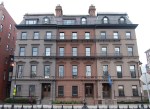
- 1-2-3 Arlington (2013)
-
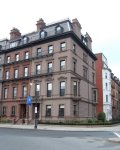
- 1 Arlington from corner (2013)
-
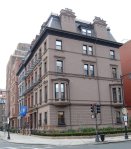
- 1 Arlington (2013)
-
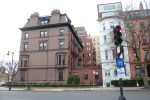
- 1 Arlington (showing rear ell) and 101 Beacon (2013)
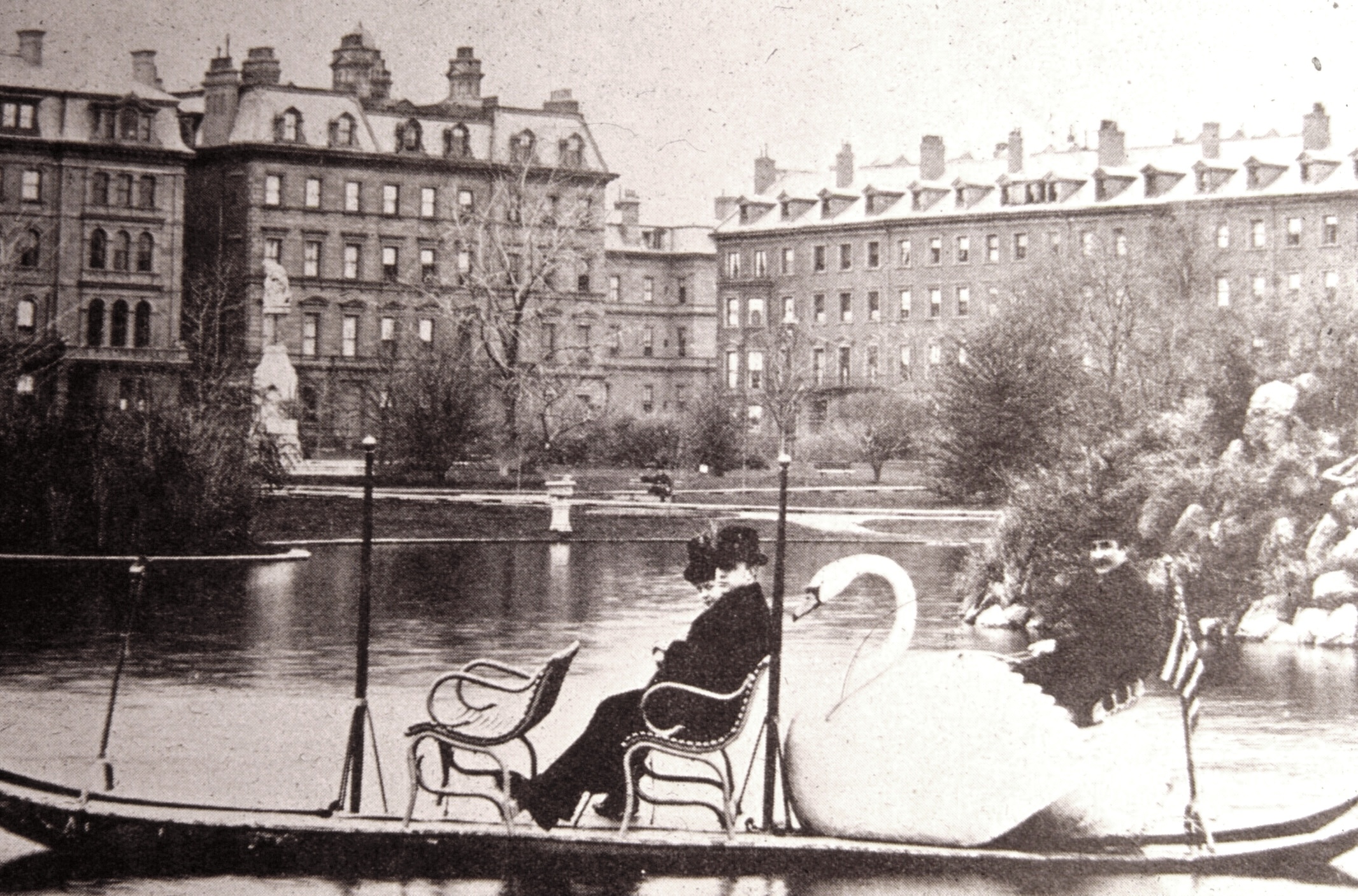
View across the Public Garden towards Arlington and Beacon (ca. 1895), courtesy of Anthony Mitchell Sammarco
 Back Bay Houses