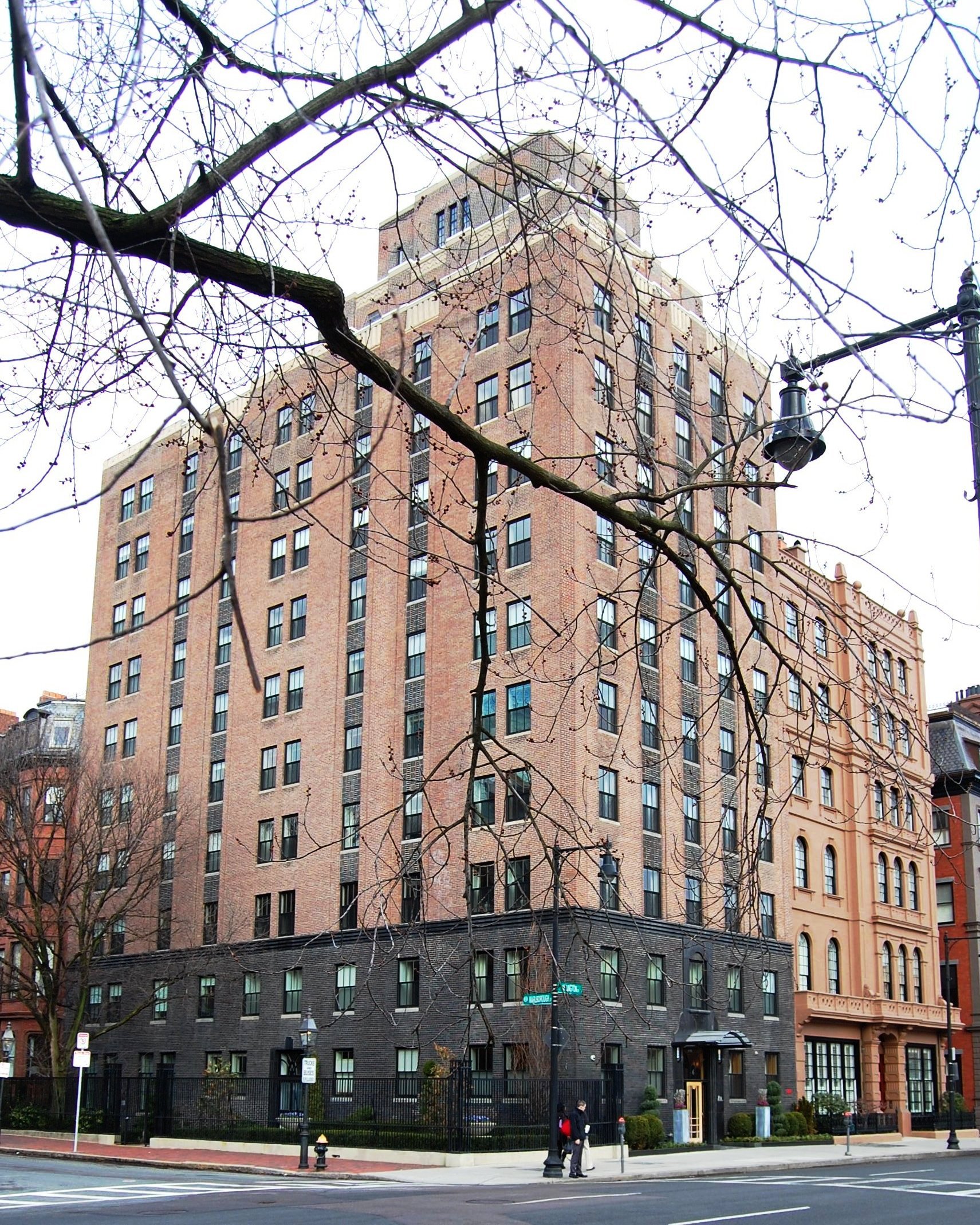
6 Arlington from corner (2013)
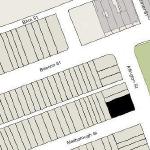
Lot 67′ x 100′ (6,700 sf)
6 Arlington (0 Marlborough) is located on the NW corner of Arlington and Marlborough, with 4-5 Arlington to the north 8-9 Arlington (00 Marlborough) to the south, across Marlborough, and 1 Marlborough to the west.
6 Arlington (0 Marlborough) was designed by architects Strickland, Blodget, and Law, and built in 1929-1930 as a ten-story (plus basement), eight-unit cooperative apartment house (at 6 Arlington) and clubrooms for the Junior League Club (at 0 Marlborough). The League previously had been located at 6 Commonwealth.
6 Arlington was built for the Six Arlington Street Trust (Elliott Henderson, Frederick Holdsworth, and Gladys B. Olmstead, trustees). The trust had acquired the townhouses at 6 and 7 Arlington on March 3, 1928, from a trust established by Charles C. Walker of Manchester, Massachusetts. It razed the two townhouses and had the new apartment house built with the address of 6 Arlington. The Six Arlington Street Trust is shown as the owner on the original building permit application, dated May 24, 1929.
Click here for an index to the deeds for 6 Arlington, and click here for further information about the land on the north side of Marlborough from Arlington to Berkeley, south of Alley 421.
Architectural plans for the building — including elevations, floor plans, land plot plans, and foundation and other structural plans — are included in the City of Boston Blueprints Collection in the Boston City Archives (reference BIN B-9).
The Junior League formally opened its clubrooms at 0 Marlborough on October 8, 1930. It occupied two floors, with an auditorium/ballroom on the ground floor and a lounge and kitchen on the second floor.
On January 25, 1934, the Six Arlington Street Trust transferred the property to Six Arlington Street, Inc.
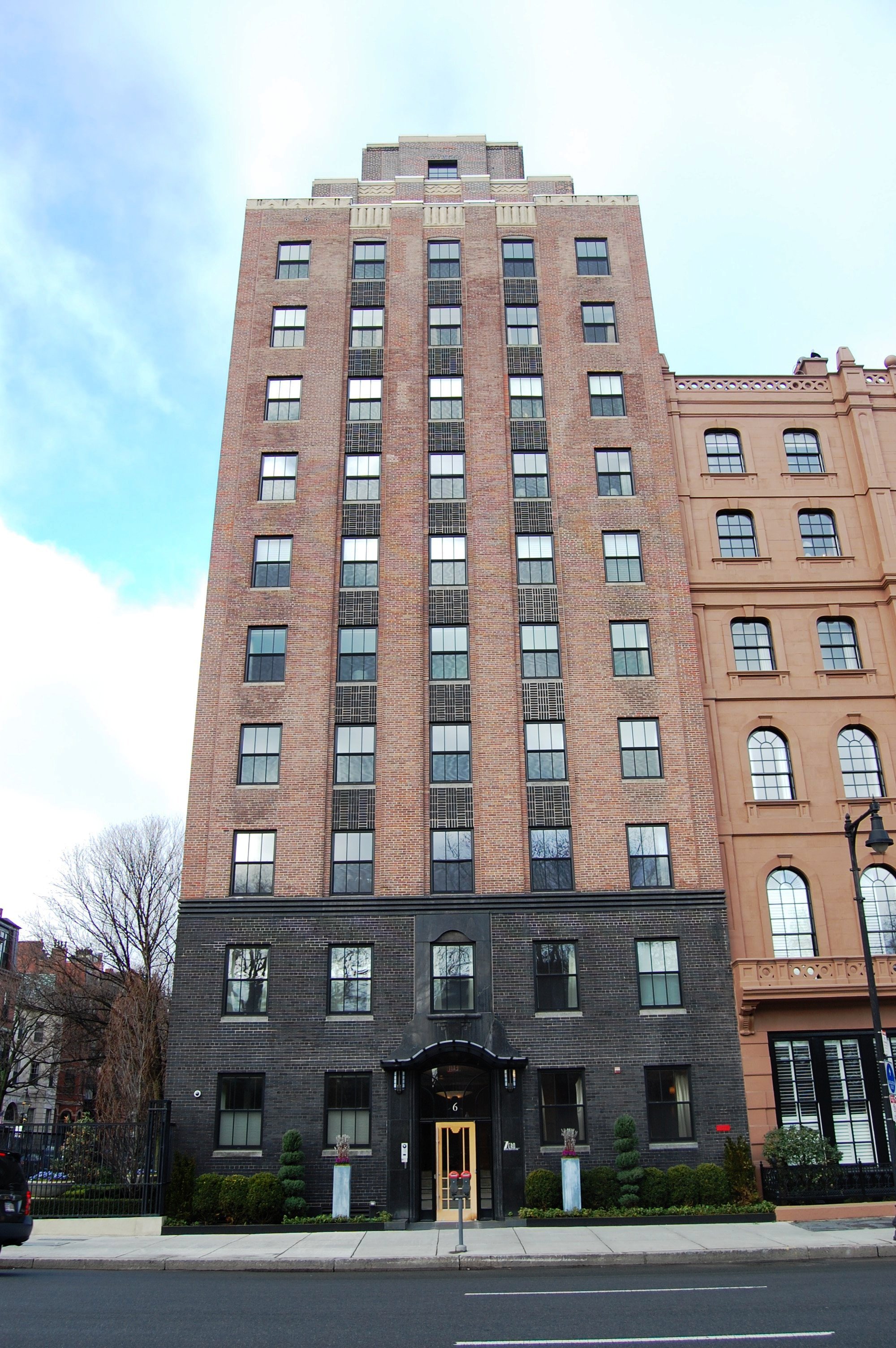
6 Arlington (2013)
In mid-1953, the Katharine Gibbs School acquired 6 Arlington through the purchase of the shares of Six Arlington Street, Inc., which remained the owner of the property.
In its August 19, 1953, article on the transaction, the Boston Globe commented that “the purchase of this property…ends a search of several years for a building that would place under one roof all of the school’s activities now housed in six units throughout the Back Bay.” That same month, the school sold five of its six buildings: 135 Commonwealth, 151 Commonwealth, 303 Dartmouth, 90 Marlborough, and 92 Marlborough. It retained the sixth, at 21–23 Marlborough, and converted it from a dormitory to classrooms.
The Boston Globe article noted that the school “expects to start operating in its new home in September, 1954, following conversion of the eight apartments at 6 Arlington st. into living quarters and classrooms. Added to these will be the space now occupied by the Junior League, including the large ballroom which will become the school’s auditorium along with offices and dining room and kitchen facilities.”
The Junior League relocated to the Harvard Club on the second floor of 380 Commonwealth, where it remained until 1958, when it purchased its own building at 117 Newbury.
On June 25, 1959, Six Arlington Street Inc. (Gordon Gibbs, president) transferred 6 Arlington to the Katharine Gibbs Realty Trust (Gordon Gibbs, Blanche L. Gibbs, and Edward L. Kane, trustees).
In May of 1962, Katharine Gibbs School also acquired 4-5 Arlington and in July of 1962, it converted the buildings into a dormitory, with doors cut through to 6 Arlington on several levels.
On February 29, 1988, the Katharine Gibbs Realty Trust sold 6 Arlington to Emerson College, which continued to operate the building as a dormitory.
On August 22, 2006, 6 Arlington was purchased form Emerson College by the 6 Arlington LLC (Jean Abouhamad, manager).
In September of 2006, 6 Arlington LLC filed for (and subsequently received) permission to remodel 6 Arlington/0 Marlborough into fifteen apartments, and in February of 2008 it applied for (and subsequently received) permission to reduce the number of apartments to twelve.
On August 19, 2008, the 6 Arlington LLC converted the building into twelve condominium units, the Zero Marlborough Condominium.
-
- 6 Arlington (2013)
-
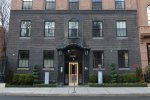
- 6 Arlington Entrance (2013)
-
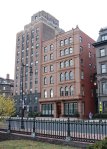
- 4-5-6 Arlington (2013)
-
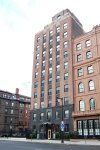
- 6 Arlington (2013)
-
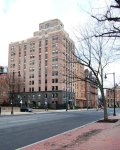
- 6 Arlington from corner (2013)
6-7 Arlington (Demolished)
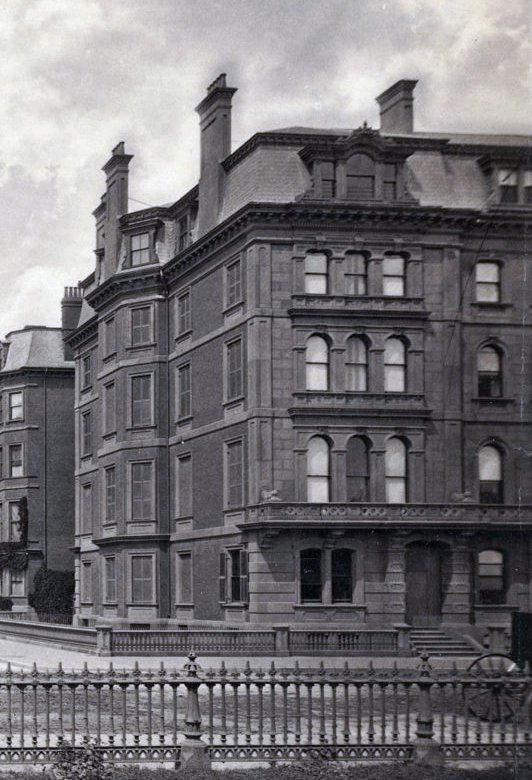
When it was built in 1929, 6 Arlington replaced two townhouses at 6 and 7 Arlington, built in 1860-1862. They had been two of four houses (4-5-6-7 Arlington) originally designed as a single symmetrical composition, with the end houses (4 Arlington and 7 Arlington) on wider lots and set slightly forward and more elaborate in design than the two middle houses (5-6 Arlington). The composition complemented similar pavilion-style French Academic designs at 1-2-3 Arlington and 8-9-10-11 Arlington. The façades of 4-5 Arlington were significantly remodeled in 1925-1926 and again in 1993-1994.
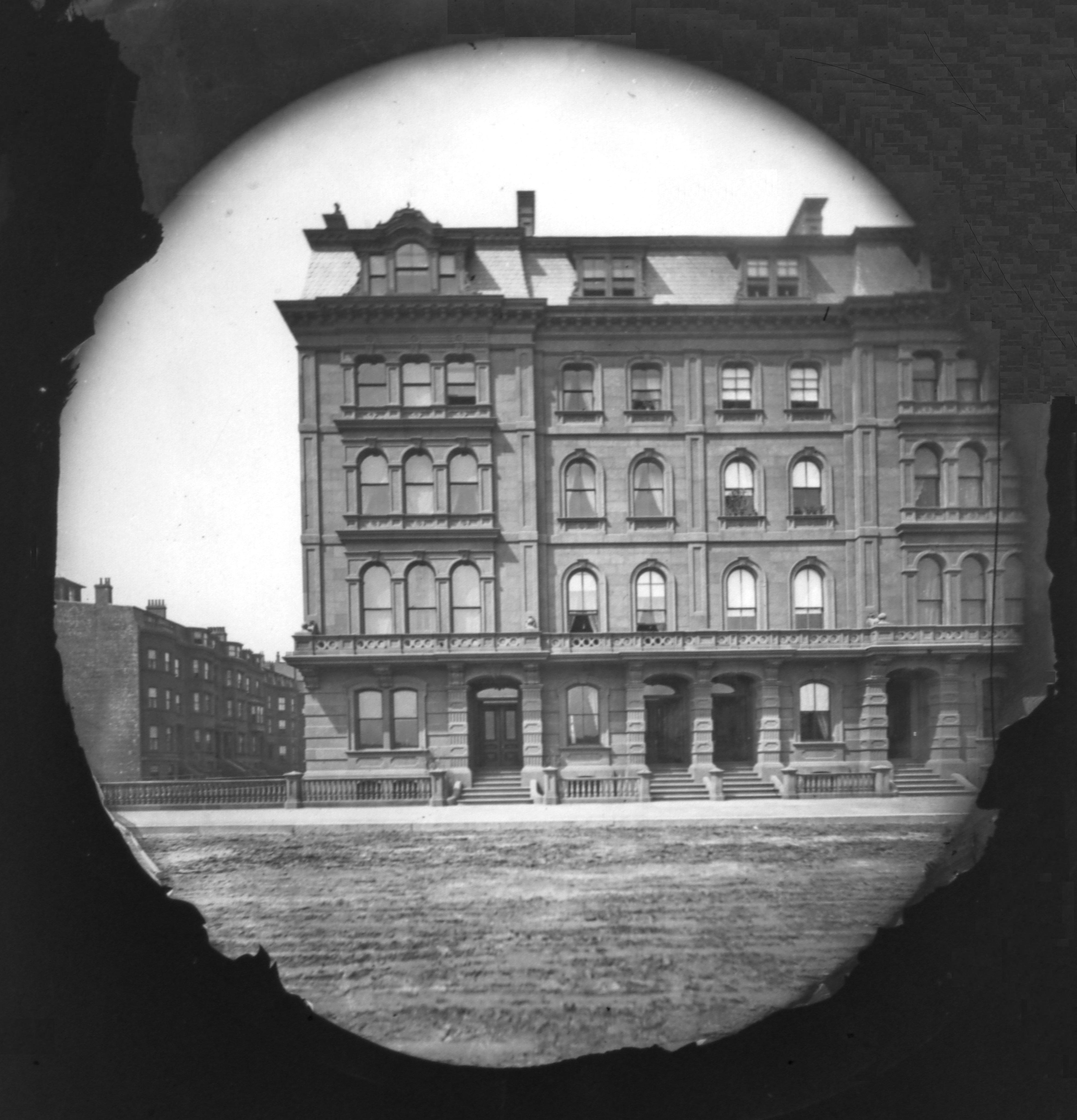
5-6-7 Arlington (ca. 1867); Josiah Johnson Hawes Collection (#459), courtesy of The John F. Kennedy Library Foundation, Boston (licensed by The John F. Kennedy Library Foundation. all rights reserved).
The land on which 4-5-6-7 Arlington were built was originally part of a larger parcel purchased from the Commonwealth of Massachusetts on September 2, 1858, by George Goss and Norman Carmine Munson, who were the contractors responsible for filling the Commonwealth’s Back Bay lands. On the same day as they purchased the land, Goss and Munson sold it to a consortium of Peleg W. Chandler, J. Amory Davis, and Henry Lee, Jr. They, in turn, subdivided the eastern portion of the parcel into four lots at 4-5-6-7 Arlington. In April of 1860, they sold the lot at 7 Arlington to William Richards Lawrence, and in May of 1860, they sold the lot at 4 Arlington to Henry Atkins.
Click here for indices to the deeds for the former houses at 6 Arlington and 7 Arlington, and click here for further information about the land on the north side of Marlborough from Arlington to Berkeley, south of Alley 421.
On May 17, 1860, Peleg Chandler and his partners entered into an agreement with William Carpenter, a carpenter, and Horace Jenkins, a mason, under which Carpenter and Jenkins agreed to build houses at 5 and 6 Arlington and, upon their completion, the partners agreed to sell Carpenter and Jenkins the land at a specified price. On May 18, 1860, William Lawrence and Henry Atkins entered into a separate agreement with Carpenter and Jenkins governing the design and construction of all four houses. On June 9, 1860, William Carpenter and Henry Jenkins filed a Notice of Intention with the Board of Aldermen to build at 4-5-6 Arlington.
The Notice of Intention filed by William Carpenter and Henry Jenkins did not include the land owned by William Lawrence at 7 Arlington. An August 7, 1861, article in the Boston Traveller describing 4-5-6 Arlington indicated that “another building is soon to be erected and attached to this block, making the corner of Arlington and Marlborough streets, by Dr. William R. Lawrence.” On September 24, 1860, the Boston Post commented that “the foundations have just been laid for four houses, intended for Henry Atkins and Dr. William Lawrence,” and that they were being “constructed under the superintendence of Horace Jenkins.” The article also noted that Horace Jenkins was supervising construction of 9-10-11 Arlington.
On September 26, 1860, Seth Simmons, a carpenter and builder, bought the lot at 5 Arlington from the partners (with the consent of Carpenter and Jenkins) and may have taken charge of building the house there.
6 Arlington (Demolished)
6 Arlington was completed in mid-1861 and purchased on August 31, 1861, by Josiah Gardner Abbott. He and his wife, Caroline (Livermore) Abbott made it their home. They previously had lived in Lowell.
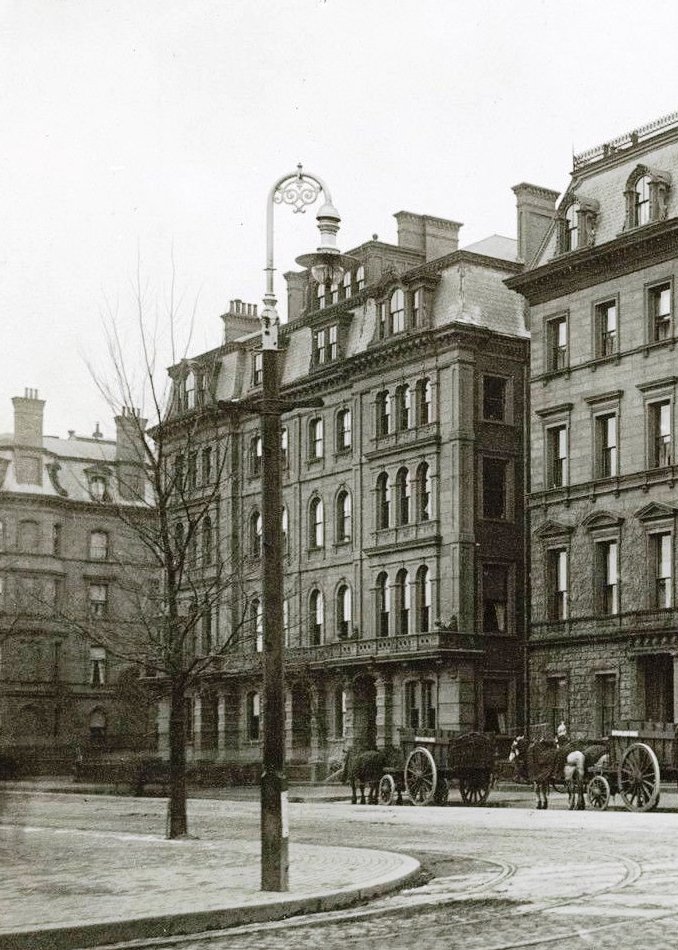
4-7 Arlington (ca. 1880); courtesy Historic New England
Josiah Abbott was an attorney. He had served as a member of the Massachusetts House of Representatives and State Senate, and was a Member of Congress in 1876-1877. He also had been an unsuccessful candidate for US Senate on several occasions.
The Abbotts continued to live at 6 Arlington in 1878, and also maintained a home, The Hundreds, in Wellesley Hills. By 1879 they had moved to a new home they had built at 317 Commonwealth.
On April 2, 1878, 6 Arlington was purchased from Josiah Abbott by wholesale liquor dealer Nathaniel F. Goldsmith and his wife Mary E. (Keith) Goldsmith. They previously had lived at 38 Staniford.
By 1880, the Goldsmiths had been joined at 6 Arlington by Mary Goldsmith’s niece, Emma R. Keith, the daughter of her brother, Phineas Keith, who had died in July of 1877, killed in the explosion of a gunpowder factory in Acton, Massachusetts, where he worked. Emma Keith’s mother, Sarah (Moser) Keith, lived in Somerville with her other children: William Franklin Keith, Ella Keith, Harriet Cora Keith, and Phineas Keith. Sarah Keith died in May of 1855 and her younger children – Ella, Harriet, and Phineas – moved to 6 Arlington to live with the Goldsmiths.
Nathaniel Goldsmith died in March of 1897.
Emma Keith married in October of 1897 to Albert Cobb Aldrich, a real estate agent and later a tea merchant and then a dealer in construction loans. After their marriage, they lived at Exeter Chambers (southeast corner of Exeter and Blagden).
Phineas Keith married in May of 1898 to Mae W. Carmichael. After their marriage, they lived in Somerville.
Ella and Harriet Keith married in October of 1901, in a double ceremony at 6 Arlington, Ella Keith to William Robert Dresser, a banker, and Harriet Keith to Charles Henry Lerned, an accountant. After their marriage, the Dressers lived in Brookline. The Lerneds lived at 6 Arlington with Mary Goldsmith until about 1903, when they moved to Melrose.
By 1915, Mary Goldsmith was joined at 6 Arlington by Albert and Emma (Keith) Aldrich. They most recently had lived in Brookline.
Mary Goldsmith continued to live at 6 Arlington until her death in October of 1919. After her death, Albert and Emma Aldrich moved back to Brookline.
On May 6, 1920, 6 Arlington was acquired from the Goldsmith estate by attorney Charles Cobb Walker, who owned and lived at 7 Arlington. 6 Arlington was not listed in the 1920-1928 Blue Books and probably was maintained as an annex to 7 Arlington.
7 Arlington (Demolished)
7 Arlington was built in 1861-1862 as the home of William Richards Lawrence and his wife, Susan Coombs (Dana) Lawrence. He purchased the land for the house in April of 1860. They previously had lived at 98 Beacon.
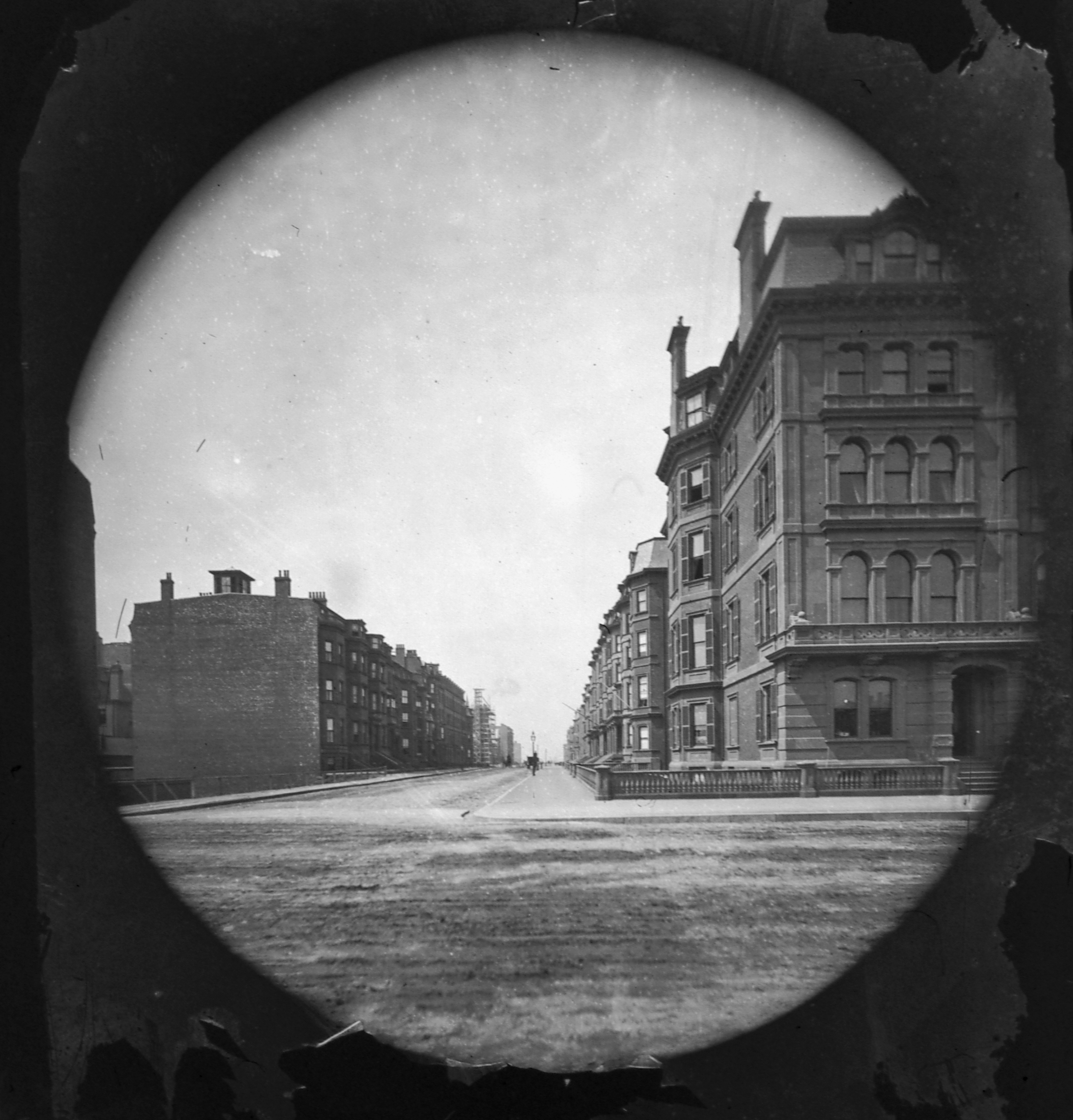
Looking west from Arlington, with 7 Arlington in the fore-ground (ca. 1867); Josiah Johnson Hawes Collection (#533), courtesy of The John F. Kennedy Library Foun-dation, Boston (licensed by The John F. Kennedy Library Foundation. all rights reserved).
After working in his family’s dry goods and textile company, William Richards Lawrence had studied medicine, graduating from Harvard Medical School in 1845. He subsequently established a children’s infirmary in Boston.
The Lawrences continued to live at 7 Arlington in 1866, but had moved to the Longwood neighborhood of Brookline by 1867.
On March 13, 1868, 7 Arlington was acquired by Peter Chardon Brooks, a real estate investor and trustee. He and his wife, Sarah (Lawrence) Brooks, the niece of William Richards Lawrence, made it their Boston home. They previously had lived at 6 Pemberton Square. They also maintained a home in West Medford.
Peter Chardon Brooks was the son of Gorham Brooks but was frequently referred to as Peter Chardon Brooks, Jr., to distinguish him from his grandfather of the same name.
In her memoirs, To be Young Was Very Heaven, Marian Lawrence Peabody, the daughter of Bishop William Lawrence (Sarah Brooks’s brother), quoted her diary from the early 1890s about a visit to her uncle Peter Chardon Brooks at 7 Arlington:
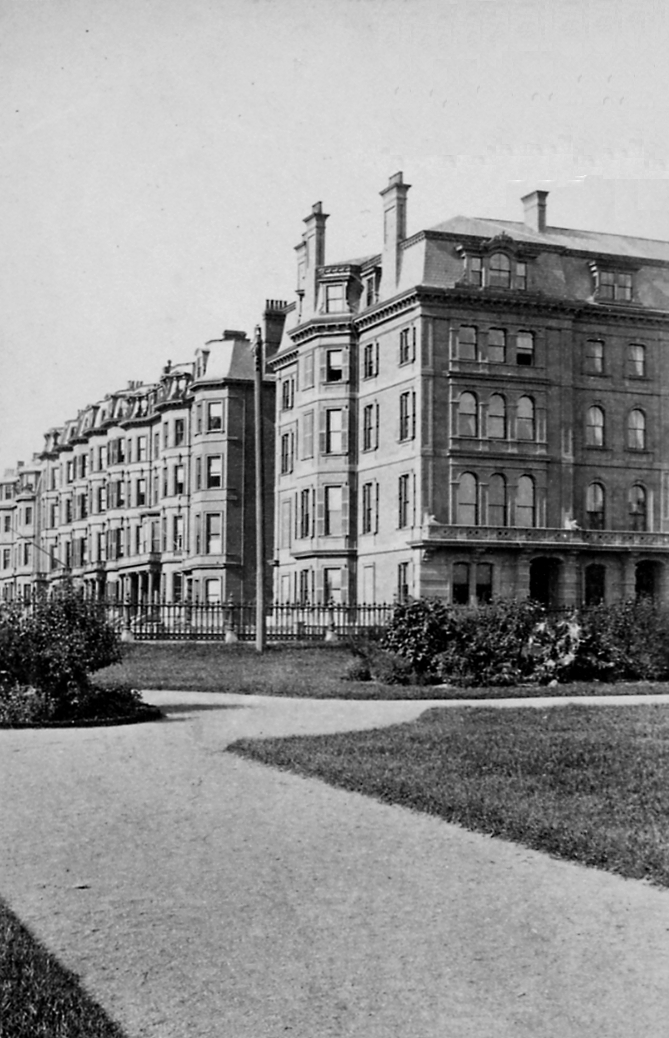
1-7 Marlborough, with 7 Arlington in foreground (ca. 1870), courtesy of the Bostonian Society.
“After dinner, Uncle Peter showed us all his new pictures by a man named Monet which have just arrived. He has always had a house full of paintings of the Barbizon School, but these are very different and very impressionistic so they cannot be hung near the others. He had them in the front hall and all up and down the long staircase. I thought they were lovely, so light and sparkling and sunny. They were mostly of the Riviera and the Mediterranean Sea, a lovely shimmering blue.”
Peter and Sarah Brooks continued to live at 7 Arlington in 1901, but had moved to 2 Deerfield by 1902.
From about 1903, 7 Arlington was the home of John Munro Longyear and his wife, Mary (Beecher) Longyear. He was an investor in timber and mining in Northwest.
The Longyears previously had lived in Marquette, Michigan, where he had served as mayor in 1890-1891 and had built a large, stone home on Lake Superior. In the early 1900s, a railroad company built tracks along the portion of the lake on which his house fronted and, in the early 1900s, he decided to move the house to Fisher Hill in Brookline. The move began in June of 1903 and was completed in 1906; the Longyears continued to live at 7 Arlington until the work was completed. John Longyear died in May of 1922. Mary Longyear continued to live in Brookline until her death in March of 1931, establishing the Longyear Foundation through which the house was dedicated to the use of the Christian Science Church and served as the Longyear Museum from 1937 to 1998.
On April 5, 1905, 7 Arlington was purchased from Peter C. Brooks by attorney Charles Cobb Walker. He previously had lived at 302 Berkeley.
7 Arlington (ca. 1880), detail from photograph taken from the Public Garden; courtesy of the Print Department, Boston Public Library
During the 1914-1915 winter season he was joined at 7 Arlington by his parents, William Bentley Walker and Marie Louise (Cobb) Walker. Their usual residence was their home, Highwood, in West Manchester. William B. Walker was a retired banker and real estate investor from Chicago. He died in July of 1919.
In May of 1920, Charles Walker acquired 6 Arlington.
In October of 1920 he married to Helene Whitehouse. After their marriage, they lived at 7 Arlington and probably maintained 6 Arlington as an annex.
During the 1925-1926 winter season, the Walkers were listed in the Blue Book both at 7 Arlington and at 29 Hereford. At the time, they were engaged in divorce proceedings, and 29 Hereford may have been the separate residence of one of them. They divorced in 1927.
By 1928, Charles Walker was living in Manchester with his mother and Helen Walker was living in an apartment at 250 Beacon.
On March 3, 1928, Charles Walker transferred 6-7 Arlington (and other property) to a trust he had established to fund divorce settlement payments to Helene Walker.
In the late 1920s, Charles Walker built a home, Woodholm, in West Manchester, adjoining his mother’s property. It subsequently became his year-round residence.
On May 19, 1929, the trust (John L. Hall and The First National Bank of Boston, trustees) sold 6-7 Arlington to Elliott Henderson, Frederick Holsworth, and Gladys B. Olmstead, trustees of the Six Arlington Street Trust. Both houses were razed later that year to permit construction of the new ten-story apartment building at 6 Arlington (0 Marlborough).

Arlington Street from the Public Garden, looking west on Marlborough (ca. 1880); courtesy of the Print Department, Boston Public Library
 Back Bay Houses