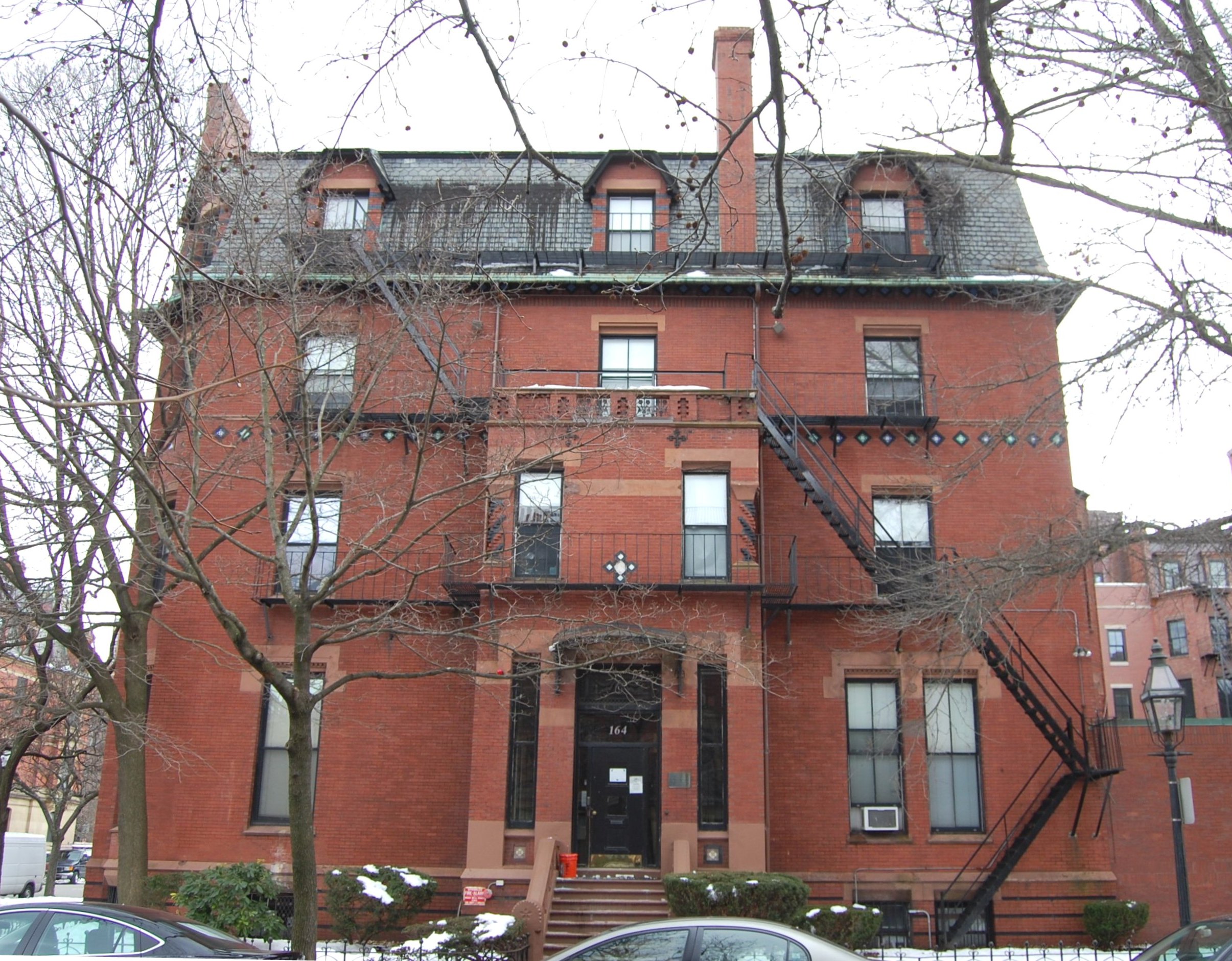
164 Marlborough (2013)
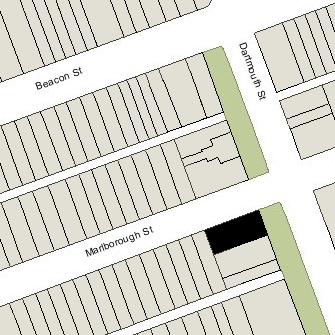
Lot 105′ x 47′ (4,935 sf)
164 Marlborough is located on the SW corner of Marlborough and Dartmouth, with 315 Dartmouth to the east, across Dartmouth, 166 Marlborough to the west, 163 Marlborough to the north, across Marlborough, and 314 Dartmouth to the south.
164 Marlborough was designed by Henry Hobson Richardson and built in 1870 as the home of dry goods merchant Benjamin William Crowninshield and his wife, Katharine May (Bradlee) Crowninshield.
164 Marlborough was built on part of a larger of parcel of land that building contractor George Wheatland, Jr., acquired from the Commonwealth of Massachusetts. He had been the successful bidder for the parcel at the Commonwealth’s auction on April 10, 1869. The parcel comprised ten lots on the south side of Marlborough, running west from Dartmouth, with a combined 255 foot frontage on Marlborough and a 112 foot frontage on Dartmouth.
He subsequently sold or transferred his right to purchase the seven lots to the west, with a frontage of 175 feet on Marlborough, to dry goods merchant Eben Dyer Jordan, co-founder of Jordan, Marsh & Co. He retained the right to buy the eastern three lots, with a frontage of 80 feet on Marlborough and 112 feet on Hereford
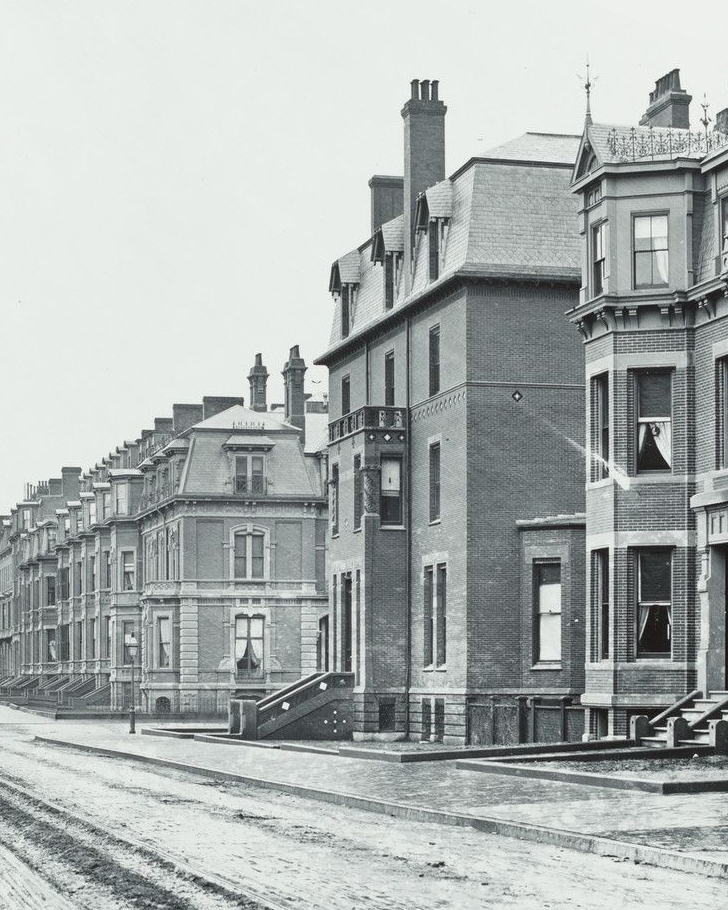
164 Marlborough (ca. 1876); detail from photograph of the south side of Marlborough, looking east; courtesy of Historic New England
On August 23, 1869, and January 23, 1869, George Wheatland, Jr., entered into agreements with Katharine Crowninshield to sell her the northern portion of the land, with an 80 foot frontage on Marlborough and 47 foot frontage on Dartmouth, with the transfer to take place after the Crowninshields had built their home on the land. On January 21, 1870, Eben Jordan agreed to sell her a seven foot wide strip of land to the west of where 164 Commonwealth was being built, increasing the Crowninshields’ lot to 87 feet on Marlborough.
164 Marlborough was completed by late 1870. On November 15, 1870, the Commonwealth conveyed the land at the corner, with an 80 foot frontage on Marlborough and 112 foot frontage on Dartmouth, to George Wheatland, Jr., and on December 6, 1870, it conveyed the lot to the west, with a 25 foot frontage on Marlborough, to Eben Jordan. On December 15, 1870, Eben Jordan sold George Wheatland, Jr., the eastern seven feet of his lot. That same day, George Wheatland, Jr., sold Katharine Crowninshield the northern portion of his lot and of the seven foot strip he had acquired from Eben Jordan. He retained the southern portion of both for 312-314 Dartmouth and began construction soon thereafter.
On April 30, 1874, Eben Jordan sold the remainder of his lot, with an 18 foot frontage on Marlborough, to George Tyson, by then the owner of 314 Dartmouth, and on July 7, 1874, George Tyson sold the portion to the west of 164 Marlborough to Katharine Crowninshield, and the portion behind 312 Dartmouth to Catherine Fay, owner of 312 Dartmouth, increasing the east-west depth of each lot to 105 feet.
In the December 15, 1870, deed transferring the land to Katharine Crowninshield, George Wheatland, Jr., had agreed to restrictions on the dimensions of the houses he would build at 312-314 Dartmouth so that they would conform with the house already constructed at 164 Marlborough. That agreement also specified that nothing would be built on a small strip of land on Dartmouth Street, about 4.5 feet deep and extending about 7.3 feet at the face of the buildings on either side of the property line between 164 Marlborough and 314 Dartmouth.
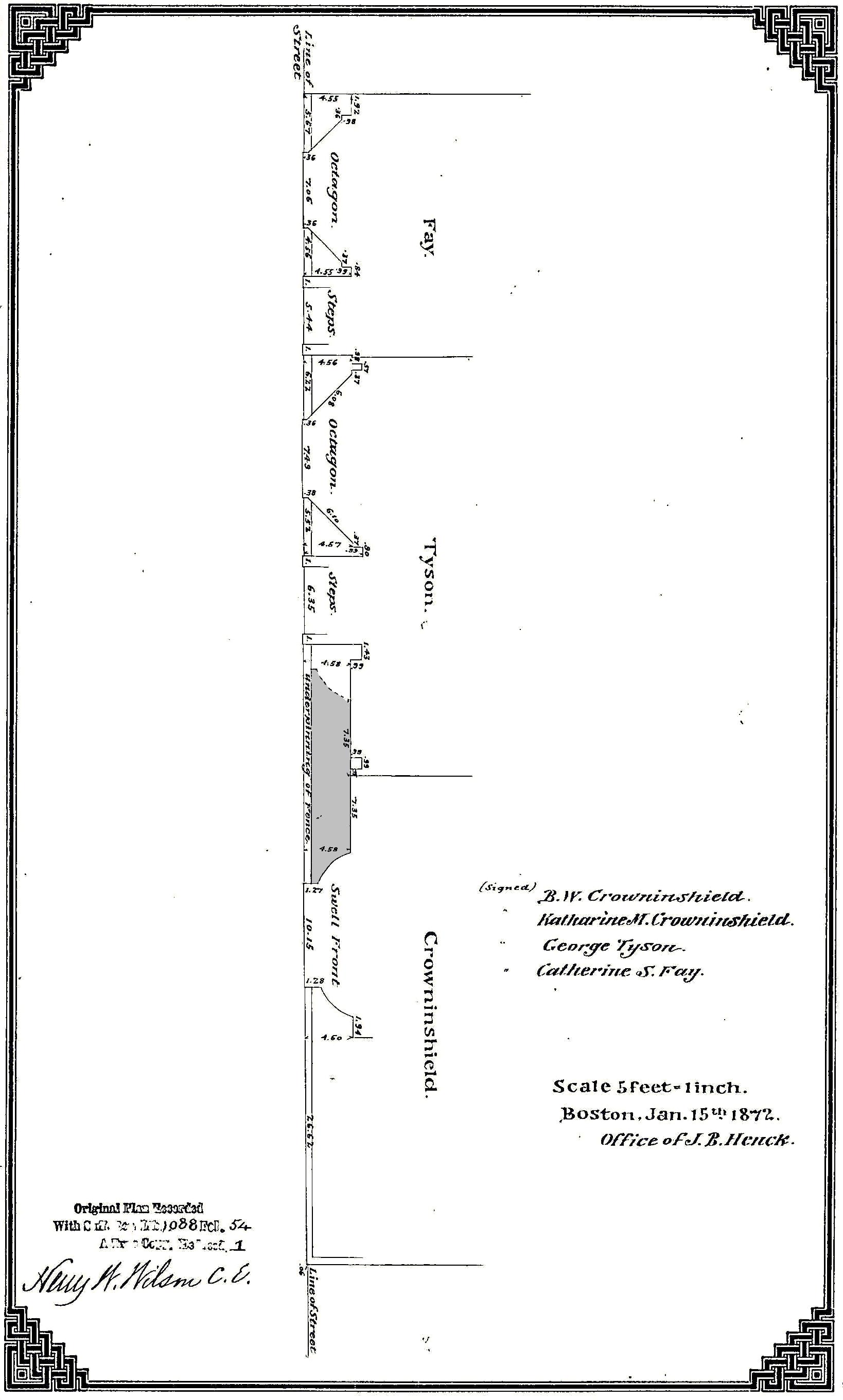
Plot plan from January of 1872 showing line of Dartmouth Street façades of 164 Marlborough and 312-314 Dartmouth as built (area where future building is prohibited shown in grey); filed with owners’ agreement, Suffolk County Deed Registry, Book 1088, p. 54 (12Jan1872)
On January 12, 1872, after 312-314 Dartmouth were completed, their new owners and Katharine Crowninshield entered into an agreement confirming that the dimensional requirements in the earlier deeds had been met and extending in perpetuity the prohibition on building on the small strip between 164 Marlborough and 314 Dartmouth.
The various deeds and agreements also specified a five foot (later four foot) wide easement at the western edge of 312-314 Dartmouth providing access and drainage from all three properties to the alley.
Click here for an index to the deeds for 164 Marlborough, and click here for further information about the land between the south side of Marlborough and Alley 425, from Dartmouth to Exeter.
After it was completed in 1870, Benjamin and Katharine Crowninshield made 164 Commonwealth their home. They previously had lived at 16 Brimmer. They also maintained a home at Peaches Point in Marblehead.
The Crowninshields’ raised their five children at 164 Commonwealth and in Marblehead: Bowdoin Bradlee Crowninshield, Francis Boardman Crowninshield, Benjamin Williams Crowninshield, Katharine Bradlee Crowninshield, and Emily Crowninshield.
During the 1884-1885 winter season, the Crowninshields were living elsewhere and 164 Marlborough was the home of Joseph Burnett, his wife, Josephine (Cutter) Burnett. They had lived at 321 Dartmouth during the previous season.
Joseph Burnett was a chemical manufacturer and maker of flavoring extracts. He owned Deerfoot, a large summer estate and dairy farm in Southborough. In 1860, he had donated the Church of St. Mark’s in Southborough, and in 1862, he founded St. Mark’s School in association with the Church.
By the 1885-1886 winter season, the Burnetts had moved to 61 Commonwealth.
The Crowninshields may have briefly resumed living at 164 Marlborough, but in the fall of 1885 they leased the house to the newly-formed Algonquin Club as its temporary clubhouse. On December 6, 1885, the Boston Globe’s “Table Gossip” column reported both that “Mr. B. W. Crowninshield has removed from 164 Marlboro street to 209 Beacon street,” and (in a separate item) that “Mr. B. W. Crowninshield and family will spend the winter in Washington.”
On December 12, 1885, the Boston Globe reported on the Algonquin Club’s plans to move to 164 Marlborough, noting that the “contracts for the furniture, draperies, carpets, crockery and glassware have been given. Mr. Preissler, who has been connected with several New York clubs, has been engaged as superintendent, and M. Auguste, formerly of the Union Club, is to be chef. The membership of the club has now reached 300.” While awaiting their new quarters, the Club met at the Hotel Vendome. The Globe’s “Table Gossip” column on December 20, 1885, provided details on the Club’s lease, reporting that it had “leased the Crowninshield House for five years and that at the end of that period they are to give up the house exactly as it now is; but in the meantime any alterations may be made. Mr. H. H. Richardson, who was the architect of the house, is to have charge of any alterations required. The Club will take possession by January 2.”
On January 9, 1886, the Boston Journal described the Club’s remodeling in detail:
“The doors open into a wide entrance hall, in which an office has been fitted up on the left of the entrance and a coat room on the right. To the left of the hall is the dining room, which is a remarkably pleasant room, having windows both on the Marlboro’ and the Dartmouth street sides. Square oak tables are placed around the sides of the room, and a massive extension table occupies the center. Across the hall from the dining room is the parlor, which also has windows on two sides. The ceiling is handsomely frescoed. The window draperies are of rich heavy stuffs, and the furniture is upholstered with plush in several shades of maroon and olive. On the second floor are four rooms. Two small ones over the parlor are for card games or general purposes, a third room over the entrance hall is for the library, and over the dining room is the café. The library has shelf room for about three hundred volumes, and the walls are adorned with a landscape in oil and several fine engravings of classical and modern subjects. The café is fitted up in much the same style as the parlor, and both this room and the card rooms are hung with spirited engravings and handsome paintings in oil. The rooms on the third and fourth floors correspond to those on the second and are to be used for general purposes, except the large room on the fourth floor, which is the billiard room, and contains a billiard and a pool table. The corresponding room on the third floor will be available for private dinners. The kitchen and store room are in the basement. …”.
On October 22, 1888, the Boston Journal reported that the Algonquin Club would move from 164 Commonwealth on November 1, noting that the “terms of the lease demanded that the club should restore the house to its original condition at the expiration of the term, but the matter has been adjusted by the payment of a satisfactory amount in lieu of alterations and the vacating of the premises one month earlier than the close of the three years.”
The Club moved to its newly-built permanent location at 217 Commonwealth at the beginning of November, 1888, and the Crowninshields resumed living at 164 Marlborough soon thereafter.
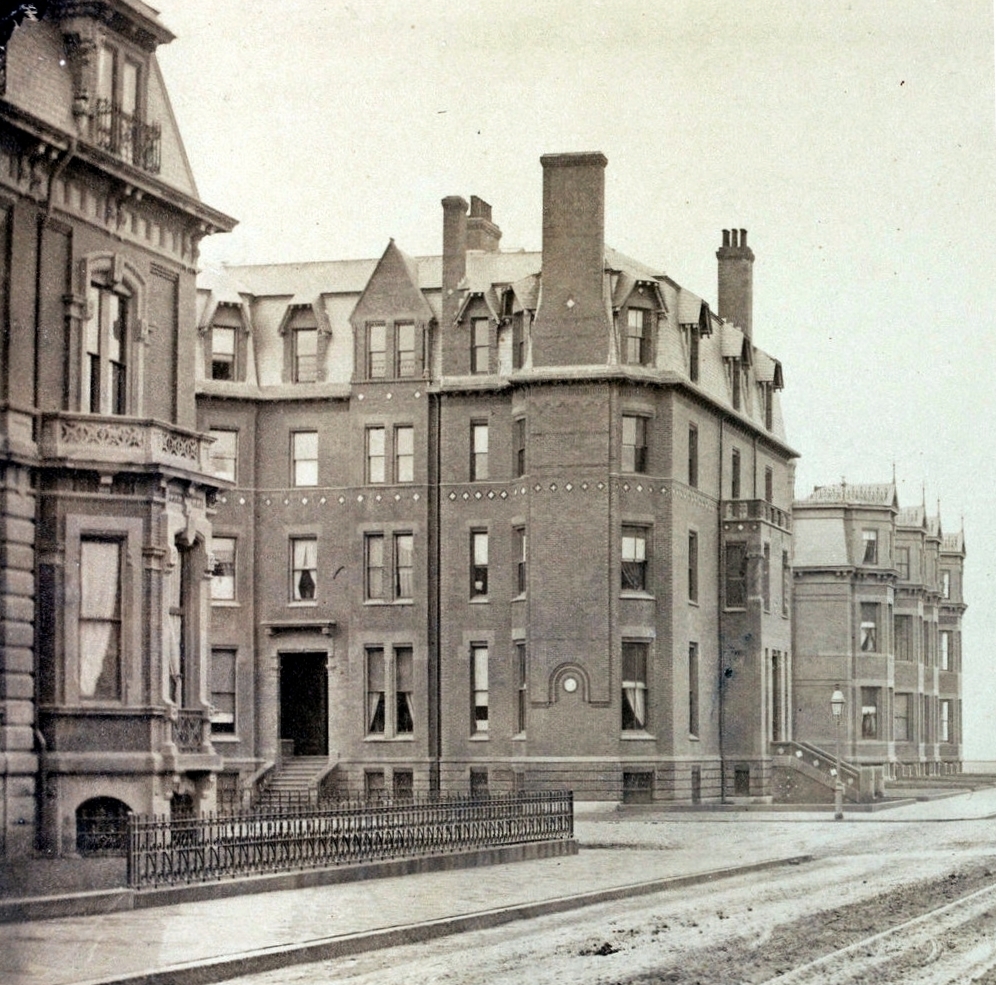
164 Marlborough (ca. 1875), detail from a photograph of the south side of Marlborough, looking west; courtesy of Historic New England
Benjamin Crowninshield died in January of 1892 in Rome, and his daughter Emily died in September of 1892.
Katharine Crowninshield continued to live at 164 Marlborough and in Marblehead with their four surviving children.
Francis Crowninshield, an insurance broker, married in June of 1900 to Louise Evelina du Pont of Winterthur, near Wilmington, Delaware. After their marriage, they lived in an apartment at 330 Dartmouth.
Bowdoin Crowninshield, a naval architect, married in May of 1901 to Priscilla Janet McPhail. After their marriage, they lived at The Metropole at 1455 Beacon in Brookline and then the New Hotel Bellevue at 19-23 Beacon; in May of 1903 they purchased and moved to 27 Hereford.
Bowdoin Crowninshield’s marriage received attention from the press because, according to the accounts in the Boston Globe and Boston Post, the couple married without the knowledge of his family or business associates. The newspapers also reported that, in July of 1900, Priscilla McPhail had filed suit against Henry Niebuhr Richards, a real estate and insurance dealer, for breach of promise. The suit apparently was not pursued and he married in January of 1901 to Mary Derby Flagg; after their marriage, they lived at 103 Marlborough.
Katharine (Bradlee) Crowninshield died in August of 1902. In her will, she left bulk of her estate, including 164 Marlborough, in equal shares to her four surviving children: Bowdoin. Francis, Benjamin, Jr., and Katharine Crowninshield. In a codicil, she specified that the portion inherited by Bowdoin Crowninshield was to be held in trust for his benefit and the benefit of his children, with the residual to be distributed to her remaining children, because he “has married without my approval and it is my desire that his wife in no event take any part of my property.”
Katharine Crowninshield married in October of 1902 to Dr. Lincoln Davis, a physician and surgeon. After their marriage, they lived at 315 Marlborough.
During the 1902-1903 winter season, 164 Marlborough was the home of Isaac Tucker Burr, Jr., a banker and broker, and his wife, Alice McClure (Peters) Burr. They also maintained homes in Nahant and Milton. During the 1899-1900 season they had lived at Haddon Hall at 282 Berkeley, and before that had made their Milton home their primary residence for several years. In the early 1890s, they had lived at 410 Beacon during the winter seasons.
By the 1903-1904 winter season, they had moved to 127 Commonwealth.
In May of 1903, Francis Boardman Crowninshield acquired his three siblings’ interests in 164 Marlborough, and he and Louise (du Pont) Crowninshield made it their Boston home. They also maintained homes at Peaches Point in Marblehead, in Boca Grande, Florida, and at the du Pont family estate, Eleutherian Mills, north of Wilmington, Delaware.
Pauline C. Metcalf, in Ogden Codman and the Decoration of Houses, indicates that Ogden Codman, Jr., provided Francis Crowninshield with interior decoration services at 164 Marlborough between 1903 and 1910.
Francis Crowninshield had served as a member of Theodore Roosevelt’s Rough Riders during the Spanish American War. He was one of the country’s leading yachtsmen and was part of the American team that won the King of Spain’s cup in 1910.
Francis Crowninshield’s younger brother, Benjamin, continued to maintain his Boston residence at 164 Marlborough, but appears to have made his home primarily in Marblehead. He was unmarried.
Louise Crowninshield’s father, Henry Algernon du Pont, was elected to the US Senate from Delaware in June of 1906, and Francis and Louise Crowninshield spent the winter seasons from 1907-1908 through 1911-1912 in Washington DC.
During the 1907-1908 winter season, 164 Marlborough was the home of Bellamy Storer and his wife, Maria (Longworth) Nichols Storer. He had been an attorney in Cincinnati and a Member of Congress. He subsequently served in Europe as US envoy to various countries, his last post being in Vienna. Maria (Longworth) Nichols Storer was an artist and, in 1880, had founded Rookwood Pottery in Cincinnati. Her nephew, Nicholas Longworth, had married in 1906 to Theodore Roosevelt’s daughter, Alice, and later served as Speaker of the House of Representatives.

164 Marlborough; Boston Globe, 27Apr1907
An April 27, 1907, Boston Globe article reporting that the Storers had leased 164 Marlborough described the house as having “more than 20 large and high-studded rooms…Its interior finish is of oak, and though the fashion of 20 years ago is very handsome.”
By the next season, the Storers had moved to 56 The Fenway.
During the 1908-1909 winter season, 164 Marlborough was the home of Eugene Van Rensselaer Thayer, Jr., and his wife, Gladys Baldwin (Brooks) Thayer. They had lived at 107 Beacon during the previous season. They also maintained a home in Lancaster. He was an investment broker, and later would become president of the Merchants National Bank in Boston and then president of Chase National Bank in New York. During the 1909-1910 season, Lancaster was their primary residence. During the 1910-1911 winter season, they made their Boston home at the Hotel Puritan at 390 Commonwealth, and in 1912 they moved to 340 Beacon.
During the 1909-1910 winter season, 164 Marlborough was the home of Dr. Elisha Flagg, a physician, and his wife, Eleanor Cecilia Amalia (Shattuck) Whitney Flagg. They had married in November of 1909, and 164 Marlborough was their first home together. Prior to their marriage, Elisha Flagg had lived at 190 Commonwealth with his mother, Euretta (Lent) Reed Flagg, the widow of George Flagg, and Eleanor (Shattuck) Whitney had lived at 14 Gloucester. They continued to live at 164 Marlborough during the 1911-1912 season, but moved thereafter to 199 Commonwealth.
By the 1912-1913 winter season, Francis and Louise Crowninshield were living at 164 Marlborough once again. In about 1923, they made their Boca Grande home their primary residence but continued to maintain 164 Marlborough as their Boston home. They continued to live there until about 1935.
From 1935 through 1949, the house was shown as vacant in the Boston City Directories, and the Crowninshields probably were living at one of their other homes. Francis Crowninshield died in May of 1950. Louise Crowninshield resumed living at 164 Marlborough as her Boston home until her death in July of 1958.
On November 16, 1959, 164 Marlborough was purchased from the estate of Louise Crowninshield by Justin William Griess and his wife, Katherine Ware (Haskell) Sears Griess. They lived at 421 Beacon.
Justin Griess was founder and owner of Yankee Maid Products, a household design and outfitting firm on Newbury Street. After he retired, he purchased and remodeled houses in the Back Bay and Beacon Hill. He also was a prominent breeder of poodles.
On September 9, 1960, 164 Commonwealth was acquired from Justin and Katherine Griess by Toba Esther Finn (Tresa E. (Finkelstein) Friedman), the former wife of Julian Friedman. She also owned 163 Marlborough, which she had purchased in April of 1959 and operated as a lodging house where it appears she resided. She previously had lived at 317 Beacon, where she also had operated a restaurant.
At about the same time as she purchased 164 Marlborough, she also leased 206 Beacon from Harry Freedman, a real estate dealer specializing in dormitories and multiple dwellings. In September of 1960, she applied for permits to convert both into lodging houses for female college students. Prior to receiving approval, she began using both houses for that purpose without providing adequate egress. She was ordered by the Building Department to vacate 206 Beacon (where there were 35 residents) and to reduce the occupancy of 164 Marlborough from 38 to ten lodgers, all to be housed on the first floor. In November of 1960, she again filed for (and subsequently received) permission to convert 164 Marlborough to a lodging house, having substantially completed the required egress and safety improvements.
On December 20, 1960, 164 Marlborough and 163 Marlborough were acquired from Toba Finn by Harry Freedman and his wife, Lillian R. (Zacks/Sacks) Freedman. They lived in Newton. On December 30, 1960, they transferred both properties to Garden Halls, Inc., dormitory operators, of which he was president and treasurer.
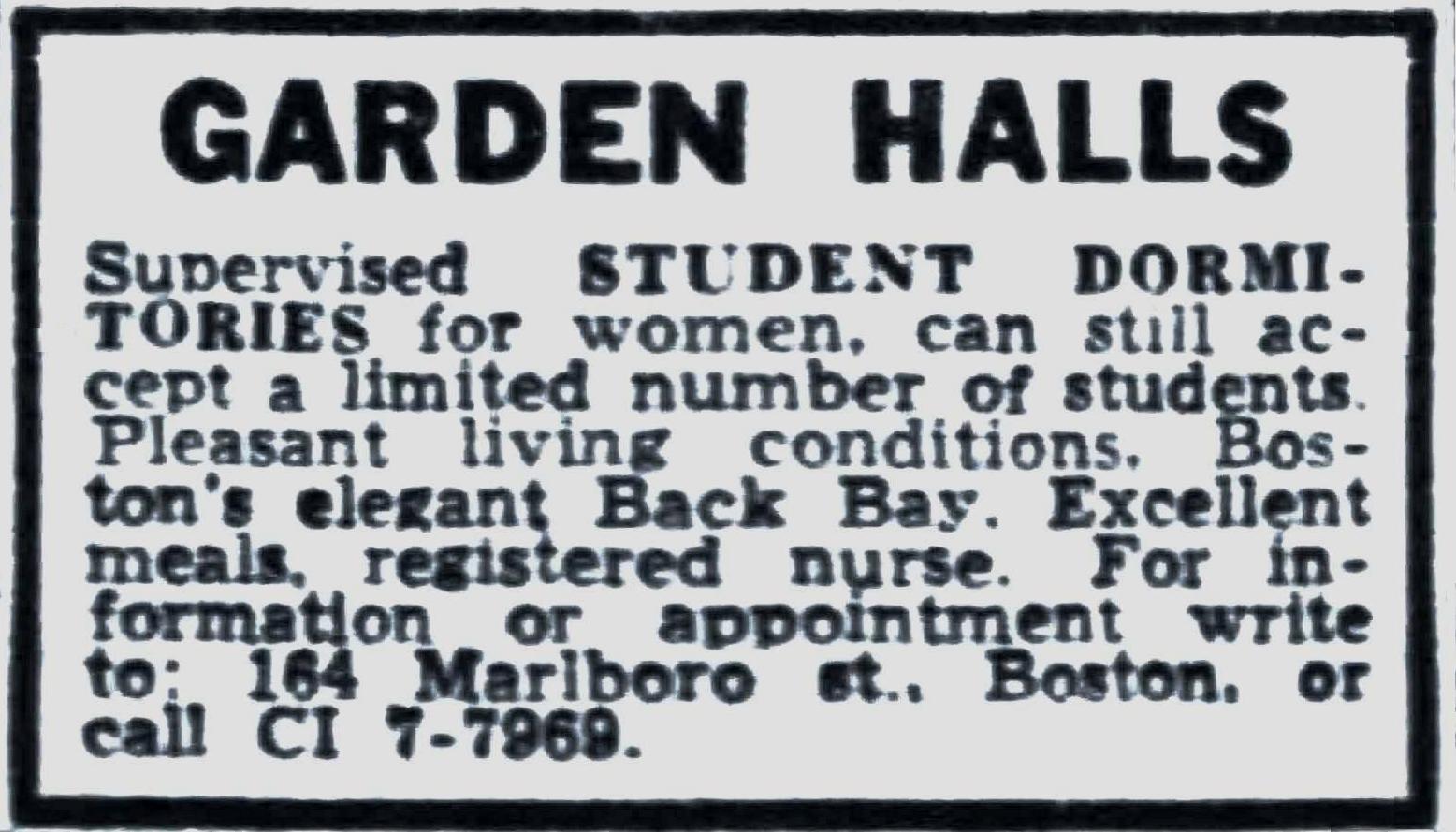
Boston Globe, 1Jul1962
In July of 1962, the Cambridge School of Business, located on Boylston, announced that both 163 Marlborough and 164 Marlborough would become women’s dormitories for their school.
In November of 1964, Garden Halls filed for (and subsequently received) permission to convert 164 Marlborough from a lodging house into a dormitory.
On November 18, 1968, 164 Marlborough and 163 Marlborough were purchased from Garden Halls, Inc., by Louis Francis Musco, Louis Francis Musco, Jr., and George Joseph Brennan, Jr., trustees of the Commonwealth Realty Trust – Special. Louis Musco and George Brennan were co-founders of Bay State Junior College (later Bay State College), located at 122 Commonwealth. Louis Musco also served as Suffolk County Register of Probate.
They continued to operate both properties as dormitories.
In 1972, 164 Marlborough was added to the National Register of Historic Places.
In May of 1974, Louis Musco, Jr., acquired 166 Marlborough. In July of 1976, when he sold it, he reserved to himself the right at some future time to increase by nine feet the height of “the present one-story building, now known as 164A Marlborough, attached to seller’s building at 164 Marlborough.” This one-story building at 164A Marlborough, which fills the entire side yard, had been built sometime after 1938 as an expansion of a previous ell located on the southern half of lot (the Building Department files do not include the permit for this addition).
In October of 1975, the Commonwealth Realty Trust – Special sold 163 Marlborough. It retained 164 Marlborough, which continued to be a dormitory in 2023.
164 Marlborough was assessed as a four-to-six family dwelling in 2024.
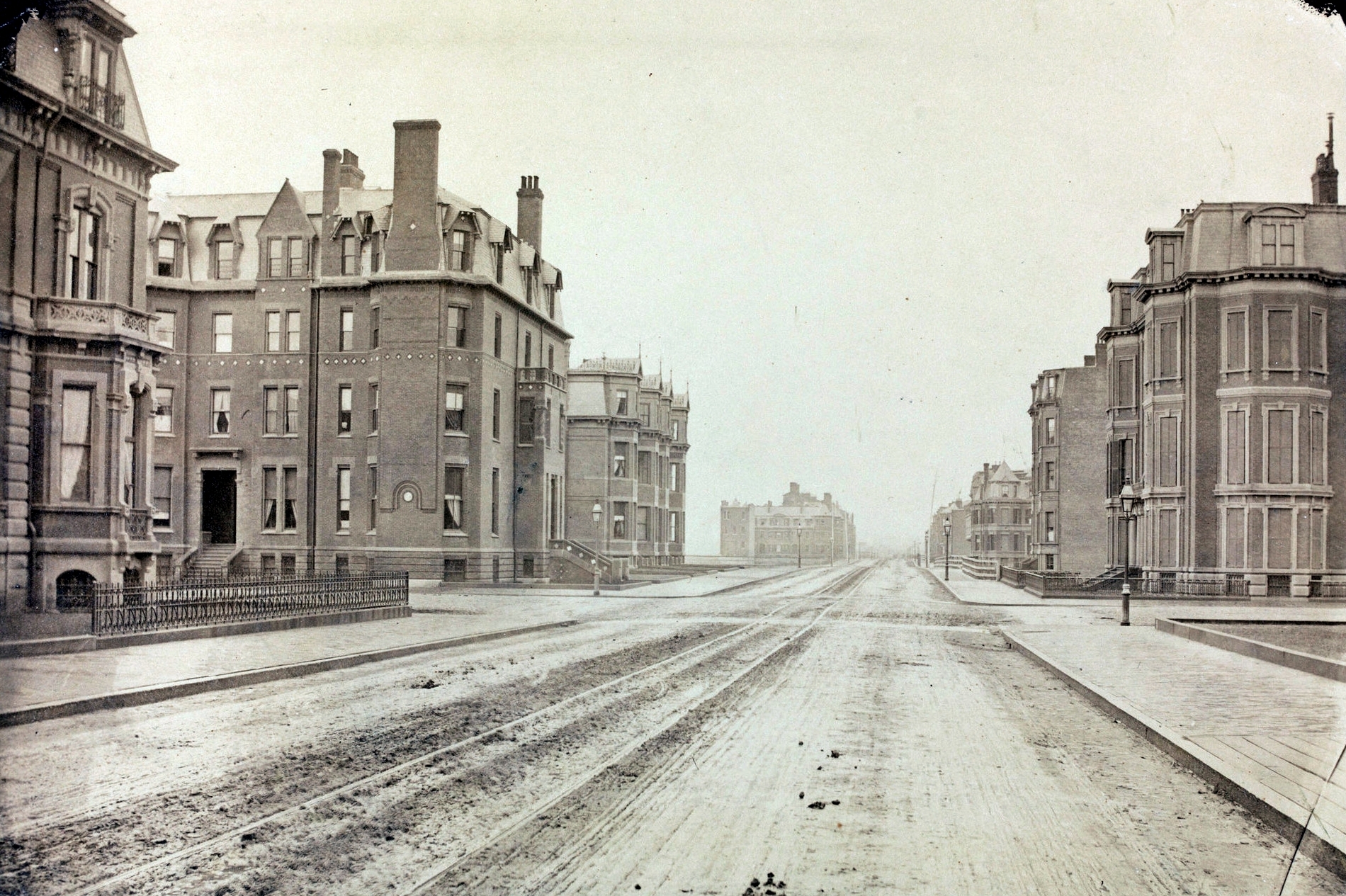
South side of Marlborough (ca. 1875), looking west from Dartmouth (315 Dartmouth in foreground on right); courtesy of Historic New England
-
- 164 Marlborough (2013)
-

- 164 Marlborough (2013)
-
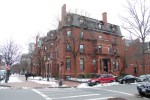
- 164 Marlborough (2013)
-

- 164 Marlborough (2013)
-
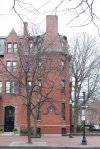
- 164 Marlborough. Dartmouth facade (2013)
-
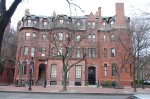
- 164 Marlborough, Dartmouth façade and 312-314 Dartmouth (2013)
 Back Bay Houses