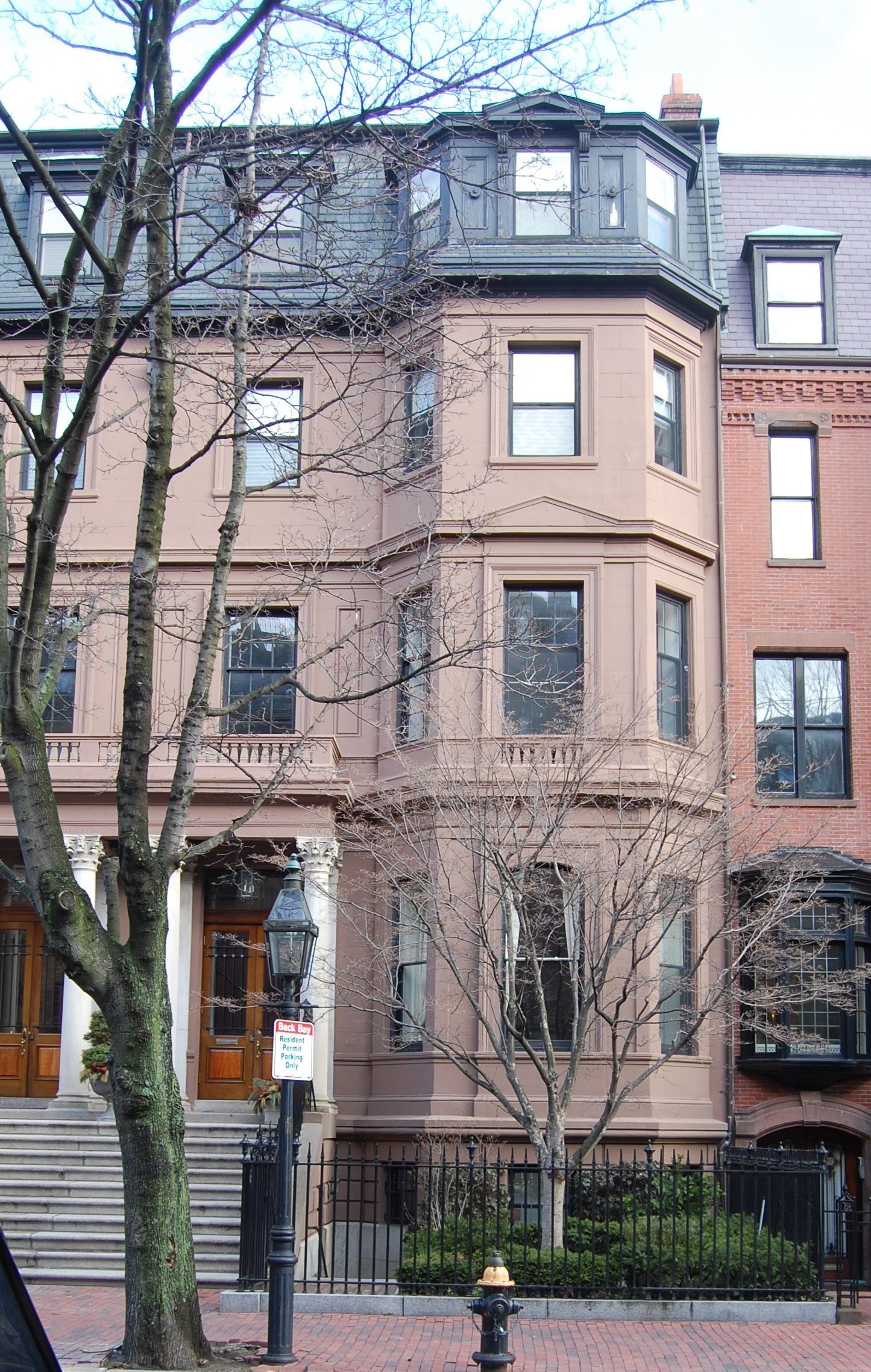
21 Marlborough (2013)

Lot 28′ x 112′ (3,136 sf)
21 Marlborough is located on the north side of Marlborough, between Arlington and Berkeley, with 19 Marlborough to the east and 23 Marlborough to the west.
21 Marlborough was built in 1866 for Charles William Freeland, for speculative sale, one of four contiguous houses (21-23-25-27 Marlborough). The four houses form two pairs of mirror opposite buildings (21-23 Marlborough and 25-27 Marlborough); each pair has a single entrance porch which creates a symmetrical entryway.
In his Houses of Boston’s Back Bay, Bainbridge Bunting does not attribute 21-27 Marlborough to a specific architect. However, a March 12, 1866, article in the Boston Evening Transcript indicates that the buildings were designed by Ware and Van Brunt. Ivory Harmon, mason, was the builder of 23 and 25 Marlborough and probably of all four houses.
Charles Freeland was a merchant, cotton manufacturer, and real estate developer. He and his wife, Sarah Ward (Harrington) Freeland, lived at 117 Beacon.
The land on which 21 Marlborough was built was part of a larger parcel of land originally purchased from the Commonwealth of Massachusetts on November 6, 1858, by George Goss. He and his partner, Norman Carmine Munson, were the contractors responsible for filling the Commonwealth’s Back Bay lands. The original parcel ran from where 9 Marlborough would be built west to Berkeley Street, comprising 17 lots with either 24 foot or 25 foot frontages. On the same day he purchased the land, George Goss sold the lots to nine different buyers, who then resold them to others.
Between July and October of 1865, Charles Freeland made a series of purchases from those who had bought land originally part of George Goss’s tract. He assembled a parcel with a frontage of 248 feet where 21-39 Marlborough would be built. He built the houses at 21-23-25-27 Marlborough for sale to others, and sold the land where 29-31-33-35 Marlborough would be built. In the case of 37-39 Marlborough, he sold the land for 39 Marlborough, but retained the land for 37 Marlborough until after the house had been built.
Click here for an index to the deeds for 21 Marlborough, and click here for further information about the land on the north side of Marlborough from Arlington to Berkeley, south of Alley 421.
On December 5, 1866, real estate dealer Robert E. Apthorp advertised in the Boston Daily Advertiser the sale of two of the four houses at 21-27 Marlborough (the advertisement does not specify which two): “Elegant houses on Marlboro’ St. Two freestone front houses on the north side of the street, very near and in full view of the Public Garden. They are 28 feet front and built in all respects with the same thoroughness, solidity and elegance of finish as the best houses on the new land. They have dining room on same floor as parlors, and 4 chambers on 2d floor.”
On October 10, 1867, 21 Marlborough was purchased from Charles Freeland by Mary Ann (Binney) Binney Hayward, the widow of Amos Binney and of Dr. George Hayward. Her first husband (also her first cousin) was a merchant and real estate dealer. A physician by training, he was a recognized natural scientist and a founder of the Boston Society of Natural History. He died in 1847 and Mary Ann Binney married again in November of 1856 to George Hayward, a widower. He was a surgeon and, in 1846, was the first physician to use ether in a surgical operation. Prior to his death in 1863, George and Mary Ann Hayward lived at 16 Pemberton Square, where she continued to live in 1866. She probably lived briefly at 21 Marlborough, but In May of 1868, she purchased 159 Beacon and made it her home.

21-23 Marlborough (2013)
On May 14, 1868, 21 Marlborough was acquired from Mary Ann Hayward by Benjamin Robbins Curtis. He and his wife, Maria Malleville (Allen) Curtis, made it their Boston home. They previously had lived at 32 Hancock. They also maintained a home in Newport.
Benjamin R. Curtis was an attorney in Boston. He served as a member of the US Supreme Court from 1851 to 1857, casting one of the two dissenting votes in the Dred Scott case. He resigned from the court soon thereafter and returned to practice in Boston. In 1871, he served as lead defense counsel in the impeachment proceedings against President Andrew Johnson.
Benjamin and Maria Curtis continued to live at 21 Marlborough until his death in September of 1874. Maria Curtis moved soon thereafter and by the 1877-1878 winter season was living at 121 Marlborough.
During the 1875-1876 and 1876-1877 winter seasons, 21 Marlborough was the home of C. H. Reeves. The house was not listed in the 1878 Blue Book.
On December 3, 1877, 21 Marlborough was acquired from the estate of Benjamin Curtis by wool and cotton merchant Lorenzo Nelson Kettle. He and his wife, Ernestine (May) Kettle made it their home. They previously had lived at 330 Walnut.
They continued to live at 21 Marlborough during the 1885-1886 winter season, but moved thereafter to The Kensington (northeast corner of Boylston and Exeter). In April of 1905 they purchased and subsequently moved to 284 Beacon.
On September 29, 1886, 21 Marlborough was purchased from Lorenzo Kettle by Miss Selma Wesselhoeft and her sister, Minna (Wesselhoeft) Otto (called Mrs. Minna Wesselhoeft), the former wife of Moritz Otto. Their mother, Ferdinande Emilia (Hecker) Wesselhoeft, the widow of Dr. Robert Wesselhoeft, lived with them. They previously had lived at 9 Newbury.
Robert Wesselhoeft, who had died in 1852, had been homeopathic physician and had operated the Wesselhoeft Water-Cure treatment facility in Brattleboro, Vermont.

Boston Post, 9Sep1889
Minna and Selma Wesselhoeft were teachers and operated a private school for girls in their home.
Ferdinande Wesselhoeft died in October of 1891. Minna and Selma Wesselhoeft continued to live at 21 Marlborough during the 1895-1896 winter season. In August of 1896, they traveled to Europe.
By the 1896-1897 winter season, 21 Marlborough was the home of Ann Bent (Ware) Winsor, the widow of Dr. Frederick Winsor, a physician. Their unmarried daughters, Mary Pickard Winsor and Elizabeth Ware Winsor, lived with her.
Mary Winsor also operated a school in the house. Her sister, Elizabeth, was a teacher in the school until her marriage in September of 1898 to Henry Greenleaf Pearson, a professor of English at MIT. After their marriage, they lived in Weston. Her brother, investment banker Robert Winsor, and his wife, Eleanor May (Magee) Winsor, also lived in Weston, where he was one of the major landowners.
Before Frederick Winsor’s death in 1889, the Winsors had lived in Winchester, where he was a physician and Ann Winsor operated a private school. Mary Winsor had taught in her mother’s school and in 1886 established a school of her own in Boston at 142 Boylston. By 1894, Mary Winsor had moved her school to 36 Newbury, where she also lived, joined by her mother (and probably her sister, Elizabeth) by 1896. When they moved to 21 Marlborough, she also moved her school there.
Ann Winsor and Mary P. Winsor continued to live at 21 Marlborough during the 1898-1899 winter season. By 1900, they (and Mary Winsor’s school) had moved to 95 Beacon. In about 1901, Ann Winsor moved to Weston. Ann Winsor continued to live and operate her school at 95 Beacon until about 1910, when it moved to a new building on The Riverway in the Fenway/Longwood district and adopted the name Winsor School.
21 Marlborough was not listed in the 1900-1901 Blue Books.
During the 1901-1902 winter season, 21 Marlborough was the home Fred Marshall Goss, a salesman, and his wife, Alma (Field) Goss. They had married in October of 1901, and 21 Marlborough probably was their first home together. They probably also operated it as a lodging house.
By the 1902-1903 winter season, 21 Marlborough and 23 Marlborough had become a lodging house operated by Myra E. (Allen) Stanley Stearns, the former wife of John H. Stearns, Jr. She lived at 23 Marlborough, probably joined by her daughter, Irene Stearns. They previously had lived and operated lodging houses at 4 Marlborough and 8 Arlington. They continued to live at 23 Marlborough in 1905, but had moved to 45-47 Mt. Vernon by the 1905-1906 winter season, where they operated The Curtis. In about 1912 Myra Stearns moved to 2 Arlington but also continued to operate The Curtis until her death in May of 1913.
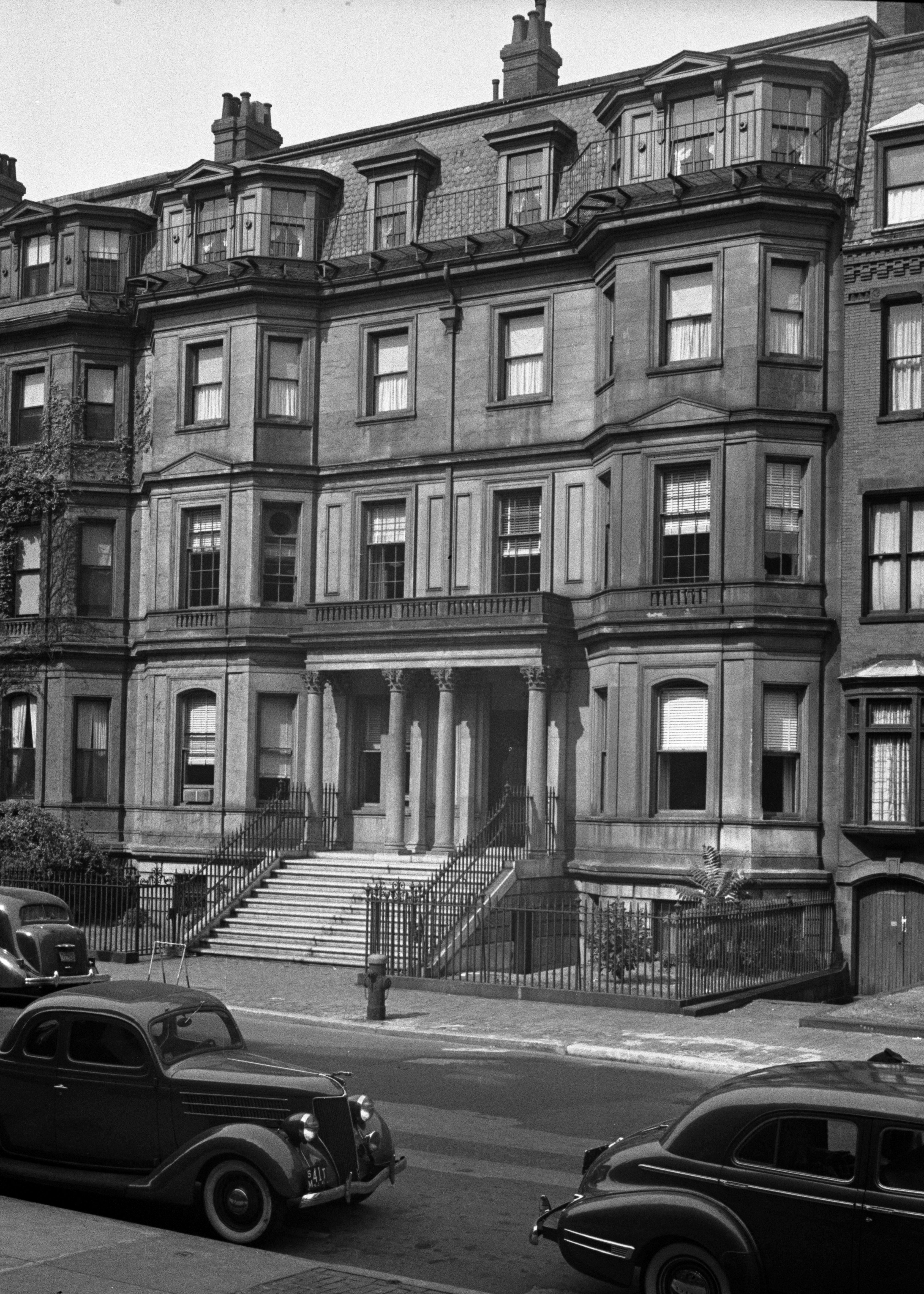
21-23 Marlborough (ca. 1942), Bainbridge Bunting Photograph Collection, courtesy of the Boston Public Library and Digital Commonwealth; licensed under a Creative Commons Attribution Non-Commercial No Derivatives License.
On May 31, 1905, Robert Winsor’s wife, Eleanor (Magee) Winsor, acquired 21 Marlborough from Minna and Selma Wesselhoeft. On the same day, she also acquired 23 Marlborough. From that time, the two houses remained under the same ownership.
The Winsors made 21-23 Marlborough their Boston home. Their primary residence was their home in Weston, Chestnut Farm. They also maintained a home in Cataumet.
During the 1912-1913 winter season, they were joined by Congressman Augustus Peabody Gardner, his wife, Constance (Lodge) Gardner, and their daughter, Constance Gardner, who was being introduced into society that season (including being feted at a ball hosted by her grandfather, US Senator Henry Cabot Lodge). Their primary residence was in Hamilton.
The Winsors continued lived at 21-23 Marlborough during the 1918-1919 winter season, after which they made their home in Weston.
On August 16, 1919, 21-23 Marlborough were purchased from the Winsors by Eleanor Vinton (Clark) Murray, the wife of Dr. Thomas Morris Murray, a physician. They previously had lived at 77 Mt. Vernon. They also maintained a home in Pomfret Centre, Connecticut.
In October of 1919, Dr. Murray filed for permission to remodel 21-23 Marlborough, including adding a story to the existing rear ells. In November, he amended the plans to also add a new 23 foot by 8 foot rear addition “to the right” (east) of the existing ell at 21 Marlborough. Both changes were subsequently allowed by the Board of Appeal on November 23, 1919. The remodeling was designed by architect William Chester Chase.
The Murrays continued to live at 21-23 Marlborough until his death in December of 1934.
On March 19, 1936, the Institution for Savings in Roxbury and its Vicinity foreclosed on its mortgage to the Murrays and took possession of 21-23 Marlborough.

21-23 Marlborough (1966), courtesy of the Boston Landmarks Commission
On August 4, 1936, 21-23 Marlborough were acquired by the Katharine Gibbs School. In July, prior to finalizing the transaction, it had filed for (and subsequently received) permission to convert the buildings into classrooms and a dormitory. Katharine Gibbs School also owned buildings at 135 Commonwealth, 151 Commonwealth, 303 Dartmouth, 90 Marlborough, and 92 Marlborough.
By the early 1940s, and possibly much earlier, the entrance to 23 Marlborough had been converted into a window, and 21 Marlborough was the primary address of the property.
In mid-1953, Katharine Gibbs School acquired 6 Arlington to consolidate its operations in one location. In August of 1953, it sold all of its buildings except 21-23 Marlborough, and in May of 1954, it converted 21-23 Marlborough entirely into classrooms, eliminating the dormitory use.
In 1968, Katharine Gibbs School was purchased by Macmillan Inc. The property was retained by the Katharine Gibbs Realty Trust.
In May of 1989, Macmillan Inc. announced plans to sell Katharine Gibbs School. The School subsequently was purchased by Phillips Colleges. Probably in anticipation of (or as a part of) the sale, on June 29, 1989, the Katharine Gibbs Realty Trust transferred 21-23 Marlborough to Macmillan Inc. At the same time, it also transferred its ownership of several other properties, including 4-5 Arlington and 86 Beacon.
On April 12, 1993, Robert G. Segel, trustee of the 21-23 Marlborough Street Realty Trust, purchased 21-23 Marlborough from Macmillan, Inc. In June of 1993, he applied for (and subsequently received) permission to convert the buildings into four apartments. As part of the remodeling, the entrance at 23 Marlborough was restored and the rear ell was rebuilt and a garage installed.
On December 21, 1993, the Trust converted the apartments into four condominium units, the 21-23 Marlborough Street Condominium.
 Back Bay Houses